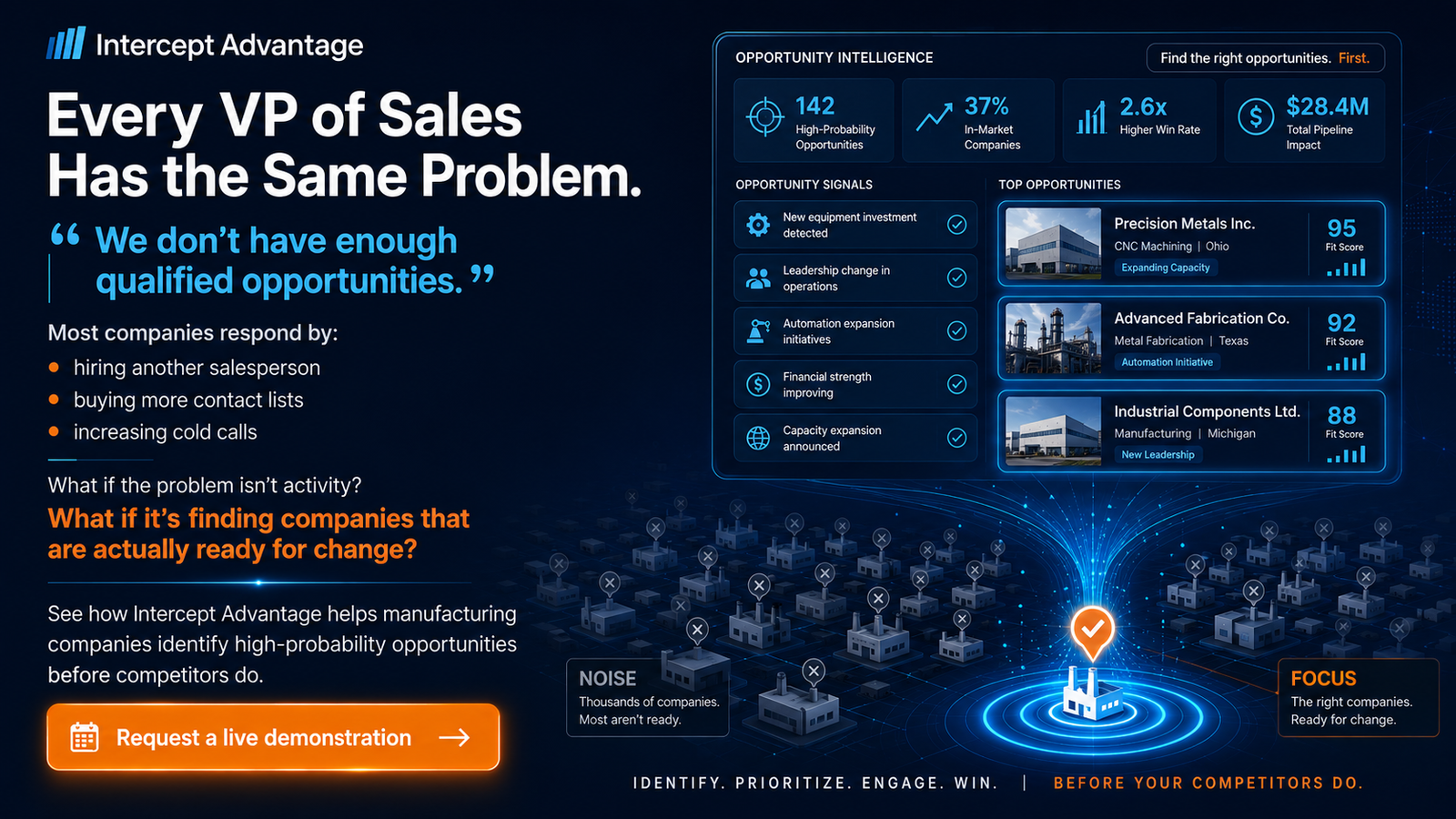
“We don’t have enough qualified opportunities.”
That sentence shows up in sales meetings everywhere.
The pipeline is too thin. Forecasts are soft. Too many deals are stalled. Too few new accounts are entering the funnel. Leadership wants more activity, more meetings, and more revenue.
Most companies respond in predictable ways:
Hire another salesperson
Buy more contact lists
Increase cold calls
Launch another outbound campaign
Push harder on follow-up
Those actions may increase activity.
They do not necessarily increase opportunity quality.
The real problem may not be a lack of sales effort.
It may be that the sales team is spending too much time on companies that are not ready to change.
More Activity Does Not Fix Weak Targeting
When pipeline is weak, activity becomes the default answer because it is easy to measure.
Calls made.
Emails sent.
Contacts added.
Meetings scheduled.
But activity is only useful when it is directed toward the right companies.
A salesperson can make 100 calls into a market where no one has a compelling reason to buy. The team may be busy, disciplined, and persistent, yet still generate very little pipeline.
That is not necessarily an execution failure.
It may be an opportunity selection failure.
The sales team is being asked to create urgency where none exists.
Qualified Does Not Mean Ready
Most companies define a qualified prospect using firmographic criteria:
Industry
Revenue
Employee count
Geography
Technology used
Number of facilities
Ownership structure
Those criteria are useful. They help identify companies that could be a fit.
But they do not answer the most important question:
Why would this company consider making a change now?
A manufacturer may match every part of your ideal customer profile and still have no interest in a new supplier.
Its current solution may be working. Its budget may be committed. Leadership may have other priorities. There may be no active project and no operational pressure.
The company is qualified on paper.
It is not necessarily an opportunity.
High-Probability Opportunities Usually Start With Change
The strongest opportunities often appear when something inside a company is moving.
That movement may include:
A facility expansion
New equipment investment
A leadership change
Increased hiring
An acquisition
A new product launch
Automation initiatives
Improving financial performance
Capacity constraints
Entry into a new market
These events create new demands and new decisions.
A company expanding production may need new suppliers, systems, contractors, equipment, or technical support.
A newly hired operations leader may review existing vendors.
An acquisition may force the company to integrate facilities, processes, systems, and purchasing relationships.
Change creates openings.
Those openings are where better sales conversations begin.
The Problem Is Not Finding Companies
Most sales teams do not suffer from a shortage of company names.
They suffer from a shortage of prioritization.
There are thousands of manufacturers in most broad target markets. The challenge is determining which ones deserve attention today.
A static contact list treats companies as though they are equally valuable.
They are not.
Some companies are stable and unlikely to make a change. Others are showing several signs that new needs are emerging.
The sales team needs to know the difference.
Without that intelligence, high-potential accounts are buried inside the noise.
Contact Lists Provide Volume, Not Context
A contact database can tell you who works at a company.
It may provide names, titles, emails, phone numbers, revenue estimates, and industry classifications.
That information is useful after you have identified the right account.
But a contact record does not explain:
What is changing inside the company
Why the company may need your solution
Which opportunity signal matters most
Why the timing may be right
What the salesperson should say
That is the gap between contact intelligence and opportunity intelligence.
One helps you reach a person.
The other helps you understand why the conversation may matter.
Hiring Another Salesperson Can Multiply the Wrong Activity
When leadership sees a pipeline problem, hiring another salesperson feels like a direct solution.
But another salesperson working from the same weak account list often produces more of the same results.
The new representative receives thousands of contacts, a CRM, a script, and a quota. Then leadership waits for pipeline.
If the underlying targeting process has not improved, the company has simply added more cost to the same problem.
Sales capacity matters only when the team has enough high-quality opportunities to pursue.
Before hiring another salesperson, leadership should ask:
Do we have a repeatable process for identifying companies that are likely to need us?
If the answer is no, the company does not yet have a salesperson shortage.
It has an opportunity intelligence shortage.
Better Opportunity Intelligence Changes the Work
A stronger process starts by identifying companies that meet two conditions:
They fit the ideal customer profile.
They are showing evidence of meaningful change.
That combination is far more valuable than fit alone.
For example, consider two manufacturers of similar size in the same industry.
The first has operated without major change for several years.
The second has announced a capacity expansion, hired a new operations leader, and begun recruiting automation engineers.
Both companies fit.
Only one is showing visible reasons why a relevant buying conversation may be timely.
That account should receive more attention.
Prioritization Makes Salespeople More Effective
Opportunity intelligence does not replace salespeople.
It improves the conditions under which they work.
Instead of asking representatives to sift through thousands of names, it directs them toward a smaller group of companies with stronger fit and timing.
That allows the salesperson to:
Research the account properly
Understand what is changing
Identify the right decision-makers
Build a relevant message
Explain why the outreach is timely
Qualify the opportunity faster
This is not less prospecting.
It is more intelligent prospecting.
Better Signals Lead to Better Conversations
Generic outreach sounds like this:
We help manufacturers improve operations and would like to introduce our services.
Signal-based outreach sounds like this:
I saw that your company is expanding production capacity and investing in automation. We help manufacturers address the systems and operational challenges that often come with expansions like this.
The second message is stronger because it begins with the prospect’s situation.
It shows awareness. It creates relevance. It gives the recipient a reason to understand why the salesperson is reaching out.
The salesperson is no longer interrupting at random.
The salesperson is responding to a visible business event.
The Goal Is Focus
A large market creates noise.
Thousands of companies may look like potential customers. Most are not ready.
The job of opportunity intelligence is to reduce that noise and create focus.
Which companies are changing?
Which changes are relevant?
Which accounts fit best?
Which opportunities should be pursued first?
When those questions are answered, the sales team can spend more time on the right companies and less time trying to manufacture interest in the wrong ones.
From Activity Metrics to Opportunity Metrics
Sales leaders should still measure activity.
But they should also measure the quality of the accounts receiving that activity.
Useful questions include:
How many target companies are showing meaningful buying signals?
How many accounts have both strong fit and strong timing?
How many opportunities have a documented reason for outreach?
How quickly are signal-based accounts converting into conversations?
Which signals consistently lead to qualified pipeline?
How much sales effort is going toward companies with no visible reason to change?
These metrics provide a clearer view of whether the team is pursuing real opportunity or simply generating motion.
Find the Right Opportunities First
The problem is not that salespeople are unwilling to work.
The problem is often that they are being asked to work through too much noise.
Intercept Advantage helps manufacturing companies identify and prioritize high-probability opportunities by detecting meaningful business changes and evaluating how closely those companies fit the ideal customer profile.
The result is not another oversized contact list.
It is a focused view of the companies most likely to be moving toward a relevant purchasing decision.
Because every VP of Sales wants more qualified opportunities.
The better answer is not always more activity.
It is finding the right opportunities first.