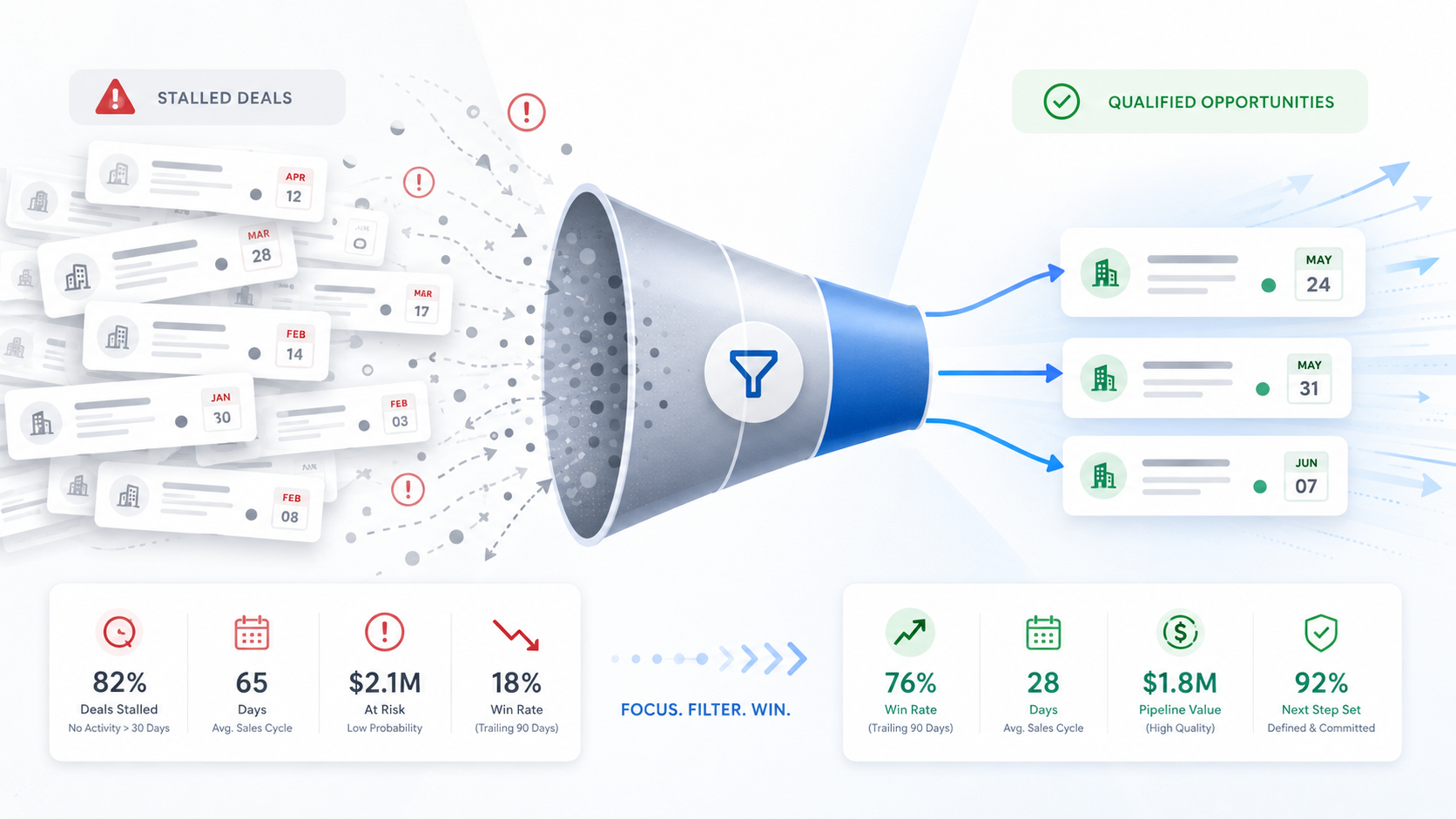
A large sales pipeline can make leadership feel confident.
There are plenty of accounts. The total potential value exceeds the revenue goal. Every salesperson appears to have business in progress.
But many pipelines are not as healthy as they look.
They are filled with companies that expressed mild interest, accepted one meeting, requested information, or said they might consider something in the future.
Those accounts may be worth monitoring.
They are not necessarily real opportunities.
Salespeople Are Rewarded for Adding Deals
Most sales organizations expect each representative to maintain adequate pipeline coverage.
That creates a natural incentive to open opportunities early and close them slowly.
A salesperson may add an account after:
A prospect responds to an email
Someone accepts an introductory meeting
A contact asks for information
A company appears to fit the target profile
A future project is mentioned
A relevant signal of change is identified
These developments can justify further investigation.
They do not confirm that a buying process exists.
When management emphasizes pipeline size without examining pipeline quality, salespeople learn that keeping questionable deals open is safer than removing them.
Interest Is Easily Mistaken for Intent
Prospects are often polite.
They may say:
“Send me something.”
“This is interesting.”
“Keep us in mind.”
“We may revisit this later.”
“Call me next quarter.”
These statements indicate interest, not necessarily buying intent.
A legitimate opportunity should contain some evidence of movement, such as:
A defined business problem
A reason to address it
An internal person willing to advance the discussion
A plausible decision process
A specific next step
A reasonable timeframe
Without those elements, the account may still be a prospect rather than an active opportunity.
Close Dates Become Works of Fiction
Weak opportunities rarely disappear on their own.
Instead, the expected close date moves.
A deal forecasted for March becomes a June opportunity. June becomes September. Eventually, the close date is pushed into next year.
Nothing meaningful has changed at the prospect.
Only the date has changed inside the CRM.
Repeatedly moving a close date is one of the clearest signs that the opportunity was never properly qualified—or that it has stalled and should be reassessed.
A real opportunity can certainly be delayed. Budgets change, projects move, and decision-makers become unavailable.
But delays should have a business explanation.
“We have not heard back” is not a buying-process stage.
Stalled Deals Hide the Real Pipeline Problem
Keeping weak deals open makes the pipeline appear stronger.
It also prevents management from seeing the actual shortage of qualified opportunities.
A sales leader looking at a $5 million pipeline may believe the team has adequate coverage. But if half of that value consists of inactive accounts with no agreed next step, the real pipeline may be much smaller.
That distinction matters for:
Revenue forecasting
Hiring decisions
Production planning
Cash-flow expectations
Marketing investments
Sales coaching
An honest pipeline may initially look uncomfortable.
It is still more useful than an optimistic one.
Every Opportunity Needs a Reason to Exist
Sales managers should be able to ask why each deal is in the pipeline.
A strong answer might include:
The company is expanding and has confirmed a related need.
A new executive is reviewing the current approach.
The prospect has defined a project and introduced the decision team.
A supplier problem has created urgency.
Funding has been approved, and evaluation is underway.
The buyer has agreed to a specific next meeting.
A weak answer sounds different:
They seemed interested.
They are a good-sized company.
They may need us someday.
We sent information.
I am waiting to hear back.
I do not want to close it yet.
The first group describes opportunities.
The second describes hope.
Use Clear Exit Criteria
A disciplined pipeline process requires rules for both entry and exit.
An account should not become an opportunity merely because outreach occurred.
It should also not remain open indefinitely without progress.
Useful exit questions include:
Has the prospect confirmed a relevant business issue?
Is there a reason to act?
Is someone inside the company engaged?
Is there an agreed next step?
Has meaningful progress occurred recently?
Is the expected timing supported by the buyer?
Would the salesperson confidently defend the forecast?
When the answers are consistently no, the opportunity should usually be returned to prospect status, placed into monitoring, or closed.
Removing a deal does not mean the company can never buy.
It means the current evidence does not justify treating it as active pipeline.
Review Movement, Not Just Value
Pipeline meetings often focus on estimated revenue.
A better review focuses on movement.
Ask:
What changed since the last review?
What did the buyer do?
What new information was confirmed?
What is the next scheduled action?
What obstacle is preventing progress?
Should this deal remain open?
A healthy opportunity advances when both the seller and the buyer take action.
Sales activity alone is not movement.
Three follow-up emails with no response do not advance a deal.
Better Opportunities Improve Pipeline Integrity
The most effective way to improve pipeline quality is to start with better prospects.
Companies showing both strong customer fit and meaningful signals of change are more likely to have a credible reason to engage than companies selected only from a static contact list.
Intercept Advantage helps identify and prioritize those companies before they reach the salesperson.
Sales then determines whether the signal has produced a real need and an active buying process.
That creates a cleaner division:
Opportunity intelligence finds the right accounts. Disciplined qualification decides what belongs in the pipeline.
A smaller, honest pipeline is not a sign of failure.
It is the foundation for better forecasting, better management, and more predictable growth.