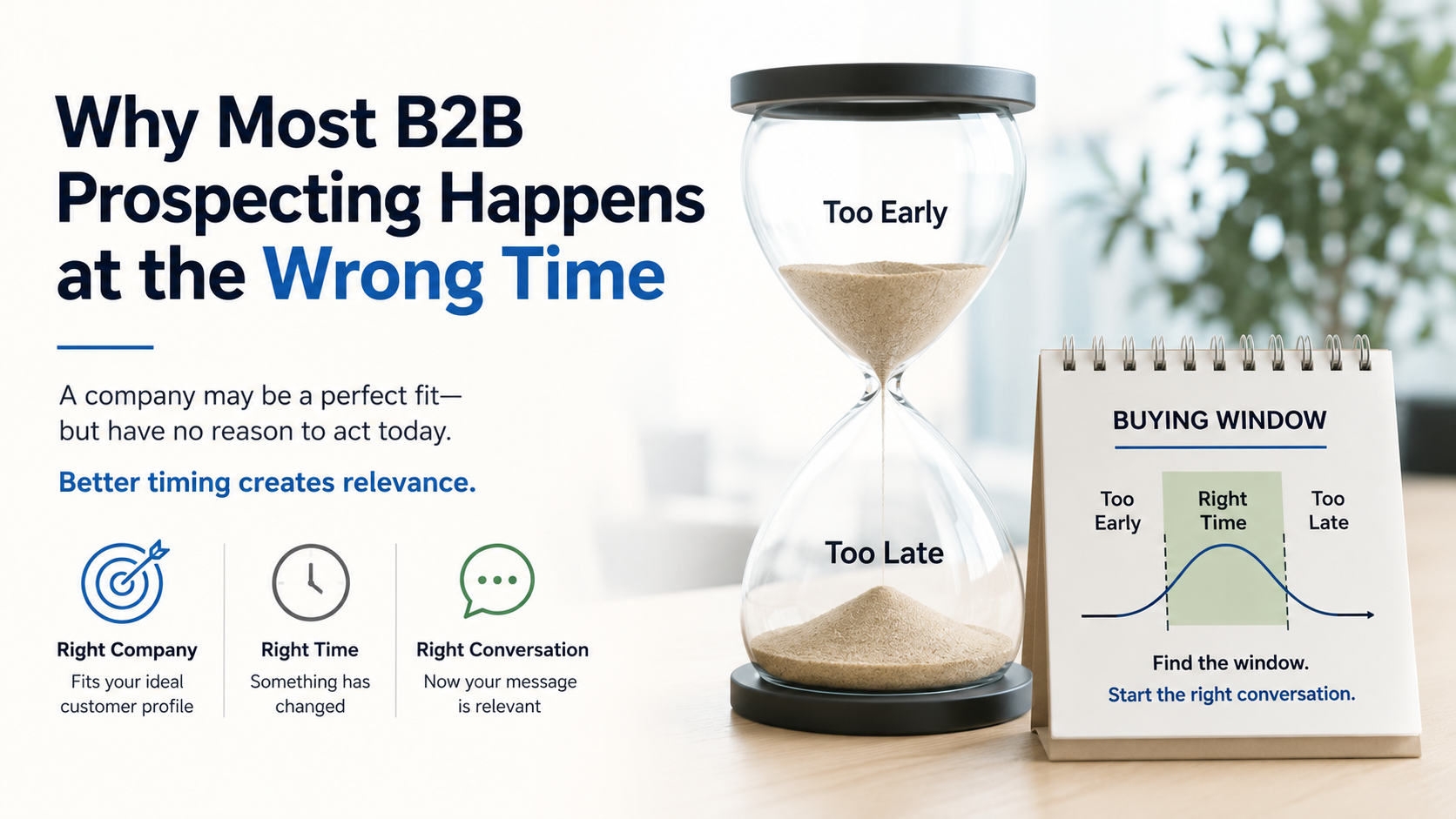
Most B2B prospecting begins with a reasonable question:
Which companies are most likely to need what we sell?
Sales and marketing teams answer that question by identifying the characteristics of a good customer.
They look for companies in the right industries, geographic markets, revenue ranges, employee counts, and operational environments. They identify the titles of likely decision-makers and build lists of organizations that resemble their best existing customers.
This is a necessary part of a disciplined sales strategy.
But it leaves out another question that may be just as important:
Why would this company consider making a change now?
A company can be an excellent fit for a product or service and still have no reason to discuss it today.
That is where much of B2B prospecting breaks down.
Good Fit Does Not Mean Good Timing
Consider a manufacturer that meets every criterion in a supplier’s ideal customer profile.
It operates in the right industry. Its revenue is large enough. Its facility uses the appropriate equipment. Its production process has problems the supplier could solve. The correct decision-makers are known.
On paper, this is exactly the kind of company the sales team should pursue.
But the manufacturer may also be satisfied with its current supplier. Its equipment may still have several years of useful life. Its capital budget may be committed elsewhere. Its leadership team may be focused on other priorities.
The company could benefit from the supplier’s solution.
That does not mean it is prepared to evaluate it.
This distinction is easy to overlook because customer fit is visible. Timing is not.
Industry, size, location, revenue, and job titles can be found in a database. The internal circumstances that might cause a company to reconsider its current approach are harder to detect.
As a result, most prospect lists answer the question of fit while leaving the question of timing almost entirely to chance.
The Typical Prospecting Model Assumes Constant Readiness
Traditional prospecting often treats every target account as though it has roughly the same likelihood of responding.
A salesperson receives a list of companies and begins contacting them.
The list may be segmented by industry, territory, company size, or job title. But within each segment, there is usually little evidence that one company has more reason to engage than another.
The salesperson works through the names in sequence.
One company may be planning a facility expansion. Another may have frozen all capital spending. One may be replacing a failed supplier. Another may have renewed a five-year contract last month.
From the sales team’s perspective, they may appear almost identical.
Both fit the profile. Both have the right contact. Both receive the same general message.
But only one may be entering a genuine buying window.
When prospecting does not account for that difference, timing becomes accidental.
The salesperson may reach a company at exactly the right moment.
More often, the salesperson is too early, too late, or entirely irrelevant to what the company is currently trying to accomplish.
Being Too Early Can Look Like Rejection
When a prospect does not respond, the sales team often interprets the silence as a lack of interest.
That may be true.
It may also mean the company has no current reason to devote time to the subject.
The need may be real but not urgent. The buyer may recognize the problem but have no budget. The company may expect to address the issue next year rather than this quarter.
A prospect contacted too early may ignore the message, decline a meeting, or say that the company is satisfied with its current approach.
Six months later, something changes.
A new executive arrives. A system fails. A major customer creates new requirements. A facility expands. A supplier raises prices or misses a deadline.
The same company that showed no interest may suddenly become highly receptive.
The original outreach was not necessarily poor.
It may simply have arrived before the business conditions were right.
Being Too Late Is Equally Common
Sales teams also discover opportunities after the important decisions have already been made.
A company announces a new facility after selecting its design partners. A manufacturer publicizes a new production line after purchasing the equipment. A business reveals an acquisition after integration planning is underway.
At that point, the event is visible—but the most valuable sales window may already be closing.
Competitors with established relationships or earlier information may already be involved.
The sales team is reacting to a public outcome rather than recognizing the earlier developments that led to it.
This is one of the hardest realities in B2B sales:
By the time a company formally enters the market, much of the buying process may already have occurred.
The supplier that helped frame the problem, evaluate the alternatives, or shape the requirements often has an advantage over suppliers that appear only after the opportunity is fully defined.
Buyers Do Not Operate on the Seller’s Calendar
Sales organizations work according to internal schedules.
They have monthly activity targets, quarterly revenue goals, annual growth plans, campaign calendars, and territory reviews.
Prospects do not organize their buying decisions around those schedules.
A company does not initiate a major purchase because a supplier needs to hit its quarterly number.
It acts because something inside or around the business has changed.
The company may face:
Increased demand
New regulatory requirements
A capacity constraint
A leadership transition
A new product launch
A geographic expansion
A supplier problem
A technology failure
An acquisition
A major customer requirement
These events create internal pressure.
That pressure may cause the company to reconsider an existing supplier, process, technology, facility, or operating model.
The buying window opens according to the customer’s circumstances, not the seller’s prospecting calendar.
Repeated Outreach Does Not Always Solve the Problem
Many companies attempt to overcome poor timing through persistence.
They place prospects into email sequences, schedule follow-up calls, send newsletters, and continue contacting the account over an extended period.
This can be useful. Staying visible increases the chance that the supplier will be remembered when a need develops.
But repeated outreach has limitations.
A generic message does not become more relevant simply because it is sent six times.
If the salesperson does not know what has changed inside the prospect’s business, the follow-up often sounds like another version of the original request:
Are you available for a brief call?
Did you see my previous email?
I wanted to follow up.
I thought I would try you again.
Do you have any upcoming needs?
These messages keep the seller visible, but they place the burden on the buyer to identify why a conversation might matter.
More effective outreach begins with a reason.
Timing Creates Relevance
The same sales message can produce very different results depending on when it arrives.
Imagine contacting a company with an offer to improve production capacity.
If the facility is operating comfortably and demand is stable, the message may receive little attention.
Now imagine contacting the same company shortly after it announces a large new customer, adds a second shift, or begins hiring production employees.
The supplier’s capabilities have not changed.
The prospect’s circumstances have.
The conversation is more relevant because the business context has created a plausible reason to engage.
This is the value of timing.
It does not guarantee that the prospect will buy. It improves the probability that the subject matters enough to justify a conversation.
Better Prospecting Requires Two Filters
A disciplined B2B prospecting process should use two distinct filters.
The first is fit.
Does this company resemble the type of organization most likely to benefit from what we provide?
The second is change.
Is something happening that could cause this company to reconsider its current approach?
Fit identifies the appropriate market.
Change helps identify the appropriate moment.
Neither is sufficient by itself.
A company experiencing major change may still be a poor customer for the supplier. A company that perfectly matches the ideal customer profile may have no reason to engage.
The strongest prospects are often found where fit and change overlap.
The Goal Is Not Perfect Prediction
No sales team can know with certainty when a company will buy.
Public information is incomplete. Internal priorities change. Some visible developments create demand, while others do not. A promising signal may lead nowhere.
The objective is not to predict every purchase.
It is to improve account prioritization.
When salespeople must choose where to spend their limited time, a company that fits the profile and is undergoing meaningful change usually deserves more attention than a similar company where nothing appears to be happening.
That is a practical improvement over working through a static list in arbitrary order.
Prospecting Should Follow the Customer’s Moment
Traditional prospecting asks:
Who should we call?
More effective prospecting adds:
Why might they listen now?
That second question changes how sales teams think about target accounts.
It shifts the focus from building larger lists to identifying better reasons for engagement. It encourages salespeople to approach prospects with context rather than a generic introduction. It helps distinguish companies that could buy someday from companies that may be approaching a decision.
The next step is understanding the types of business changes that cause companies to reconsider their suppliers, systems, and operating decisions.