Most B2B companies understand the value of an Ideal Customer Profile.
An ICP helps sales and marketing teams define the types of companies most likely to become profitable customers. It establishes clear criteria for industry, size, geography, operating characteristics, technology, buying roles, and other factors that matter.
Without an ICP, prospecting becomes unfocused.
Salespeople pursue companies that are too small, too large, too distant, poorly aligned, or unlikely to need the solution. Marketing generates leads that look active but do not fit the business. Contact databases grow without producing a clear sense of priority.
A documented ICP helps correct those problems.
But it cannot answer every question the sales team needs answered.
Most importantly, it cannot tell the team which companies are likely to act now.
What an ICP Does Well
A strong ICP identifies the characteristics shared by the company’s best customers.
Depending on the business, those characteristics may include:
Industry
Revenue
Employee count
Number and type of facilities
Geography
Equipment or technology in use
Production processes
Regulatory environment
Product applications
Growth stage
Purchasing structure
Relevant decision-makers
These criteria help define the market.
They allow the company to distinguish between organizations that are broadly appropriate and those that are unlikely to become good customers.
This improves focus.
Instead of telling the sales team to pursue every manufacturer in the country, the company may target manufacturers in specific industries, within a defined revenue range, operating multiple facilities, and using a particular production process.
That is a meaningful improvement.
The ICP Answers “Who?”
At its core, an ICP answers a demographic and operational question:
Who resembles the type of company we serve best?
That is essential.
A supplier of highly engineered industrial components should not spend the same amount of time on every business that might technically purchase a part.
A construction firm specializing in large capital projects should not pursue every organization that owns a building.
A software provider designed for multi-location businesses should not treat a single-location company as equivalent to a national operator.
The ICP narrows the universe.
It helps the organization decide where to look.
But it does not reveal what is happening inside those companies.
Two Identical Companies Can Have Very Different Sales Potential
Consider two manufacturers that match the same ICP.
Both operate in the same industry. Both have similar revenue. Both own several facilities. Both use equipment that depends on the supplier’s products.
From a database perspective, the two companies may appear almost identical.
But their business circumstances may be completely different.
Company A is operating normally. Its leadership is stable. It has no major projects planned. Its current suppliers are performing adequately. Capital spending has been postponed.
Company B has just announced a new facility, hired a vice president of operations, added a production line, and begun recruiting engineers.
Both companies fit the ICP.
Only one is showing visible evidence of change.
The ICP cannot distinguish between them because both match the same profile.
Fit Describes Potential, Not Readiness
A company that fits the ICP has the potential to become a customer.
That does not make it a qualified opportunity.
The company may have no approved project. It may have no budget. It may be satisfied with its current supplier. Its priorities may be focused elsewhere.
The company could buy someday.
That is different from having a reason to investigate a purchase now.
This is where sales organizations often ask too much of the ICP.
They expect the profile to identify not only the right companies but also the best prospects.
Those are related, but they are not the same.
The ICP identifies fit.
Readiness requires additional evidence.
Static Profiles Cannot Capture Dynamic Conditions
Most ICP criteria change slowly.
A company’s industry, size, geography, facility count, and operating model may remain relatively stable for years.
Buying conditions are much more dynamic.
A company may:
Begin an expansion
Hire a new executive
Win a major contract
Lose a critical supplier
Enter a new market
Face a regulatory deadline
Announce a capital investment
Acquire another business
Experience rapid hiring
Launch a new product
These developments may significantly alter the company’s priorities without changing its basic ICP characteristics.
The company looks the same in the database.
Its commercial circumstances have changed.
A static profile is not designed to capture that movement.
The ICP Can Produce a Very Large Universe
Many B2B companies operate in broad markets.
Even after applying reasonable ICP criteria, the resulting universe may contain thousands of companies.
That creates another problem.
The sales team cannot investigate and contact every account with equal depth.
It must decide where to begin.
Without a second layer of prioritization, salespeople may work alphabetically, geographically, by company size, or according to whichever accounts happen to appear in a list.
None of those methods necessarily identifies the companies most likely to engage.
The ICP narrows the market.
It may not narrow it enough.
Contact Data Adds Access, Not Urgency
Once the target companies are identified, the next step is usually to find the relevant people.
Contact databases can provide names, titles, phone numbers, email addresses, reporting relationships, and employment history.
This information is valuable.
It helps salespeople reach the correct executives, engineers, operations leaders, purchasing managers, or facility personnel.
But knowing whom to call does not answer why that person should speak with the salesperson.
Contact data creates access.
It does not create relevance.
The sales team still needs a credible reason for the conversation.
Firmographic Scores Have the Same Limitation
Some organizations assign scores to target accounts based on ICP fit.
A company may receive points for being in the right industry, exceeding a revenue threshold, operating multiple facilities, or employing particular job functions.
The highest-scoring companies appear at the top of the list.
This is better than treating every company equally.
But the score still reflects what the company is, not what the company is doing.
A large, perfect-fit account with no active need may receive a higher score than a somewhat smaller account that has just announced a major project.
The fit score is not wrong.
It is incomplete.
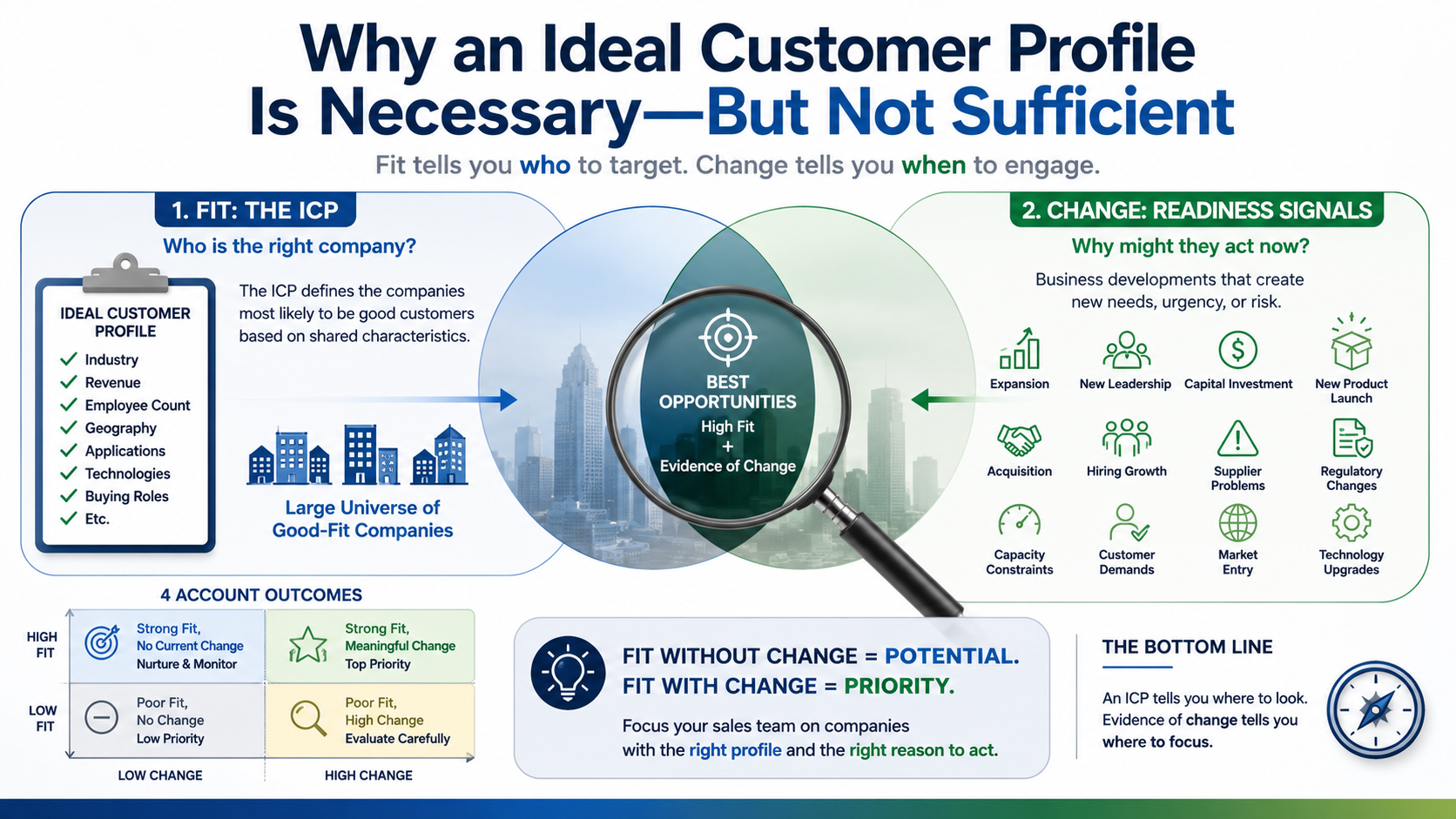
A Better Model Uses Two Dimensions
A more useful approach separates account qualification into two dimensions.
1. Fit
Does the company resemble the type of organization most likely to benefit from the solution?
This includes the traditional ICP criteria:
Industry
Size
Geography
Application
Technology
Facility type
Decision structure
Commercial value
2. Change
Is something happening that could create a new need, new urgency, or a reason to reconsider the current approach?
This may include:
Expansion
Leadership turnover
Capital investment
Hiring
Product launches
Acquisitions
Supplier problems
Regulatory changes
Capacity pressure
Customer-driven requirements
Fit identifies the right company.
Change suggests the right moment.
The strongest sales prospects are often found where the two overlap.
Four Types of Accounts
Combining fit and change creates four practical account categories.
High Fit, High Change
These are the highest-priority accounts.
They resemble strong customers and are experiencing developments that may create a reason to engage.
The sales team should investigate them promptly and approach them with relevant context.
High Fit, Low Change
These are valuable long-term targets.
They deserve ongoing visibility, relationship development, and light monitoring, but they may not justify intensive pursuit today.
Low Fit, High Change
These companies may be active, but the opportunity may not align well with the supplier’s capabilities.
The change should be reviewed, but activity alone should not override poor fit.
Low Fit, Low Change
These accounts usually deserve little immediate attention.
They neither resemble strong customers nor show evidence of a developing need.
This framework helps the sales team allocate time more intelligently.
The ICP Still Matters
Recognizing the limitations of the ICP does not reduce its importance.
Without a clear profile, change signals can create enormous noise.
News feeds, press releases, job postings, funding announcements, construction activity, executive changes, and market developments produce more information than any sales team can evaluate manually.
The ICP provides the filter.
It helps determine which companies and events matter.
A plant expansion at a company outside the target market may be irrelevant. The same expansion at a high-value target account may deserve immediate investigation.
The profile establishes strategic focus.
Change adds commercial timing.
Qualification Should Happen in Stages
A practical qualification process may look like this:
Does the company fit the ICP?
Confirm the basic market, size, application, geography, and commercial criteria.What has changed?
Identify any event, initiative, risk, or investment that may affect the business.What could the change create?
Determine whether it may create a need the supplier can address.Who is likely to care?
Identify the executive, technical, operational, or purchasing roles most affected.Is there a credible reason to engage now?
Decide whether the account deserves immediate sales attention, continued monitoring, or no action.
This process does not guarantee that the company will buy.
It improves the quality of the decision to pursue it.
Better Prioritization Protects Sales Capacity
Salespeople cannot give every target account equal attention.
Their time is too valuable.
A high-fit company with no visible movement may deserve a different level of effort than a high-fit company that is hiring, expanding, investing, or changing leadership.
Without that distinction, sales teams often spend their best hours on the largest or most recognizable accounts rather than the accounts with the strongest current business reason to engage.
The result is familiar:
More activity
Low response
Slow-moving pipelines
Long periods of follow-up
Few qualified opportunities
The ICP solves the focus problem.
It does not fully solve the priority problem.
The ICP Defines Where to Look
The Ideal Customer Profile remains one of the most important tools in B2B sales and marketing.
It defines the market. It improves list quality. It aligns sales and marketing. It prevents teams from chasing companies that are unlikely to become profitable customers.
But it should not be treated as a complete opportunity-identification system.
The ICP tells the organization:
These are the kinds of companies we should care about.
The next question is:
Which of these companies is experiencing a change that may create a reason to act?
Answering that question requires understanding the visible business developments that indicate movement inside a target account.
Those developments are signals of change.