Most companies do not wake up one morning and decide to replace a supplier for no reason.
Existing relationships are comfortable.
The supplier is already approved. The purchasing process is familiar. Employees know how the product or service works. Pricing has been negotiated. Switching would require time, attention, and some degree of risk.
Even when the current arrangement is imperfect, staying with it may feel easier than making a change.
That is why salespeople often struggle to persuade otherwise qualified prospects to consider something new.
The problem may not be the message.
The company may simply have no reason to disturb the status quo.
The Status Quo Is Stronger Than It Looks
From the outside, a prospect’s current arrangement may appear vulnerable.
The supplier may be expensive. Service may be inconsistent. The technology may be outdated. The process may be inefficient. A competitor may offer better performance.
But companies tolerate imperfect systems and suppliers every day.
Changing requires work.
Someone must identify alternatives, gather information, obtain internal support, compare proposals, negotiate terms, and manage the transition. The buyer may also be held responsible if the new solution fails.
That creates a natural bias toward leaving things alone.
A current supplier does not need to be exceptional to remain in place.
It often needs to be merely acceptable.
Change Usually Creates the Opening
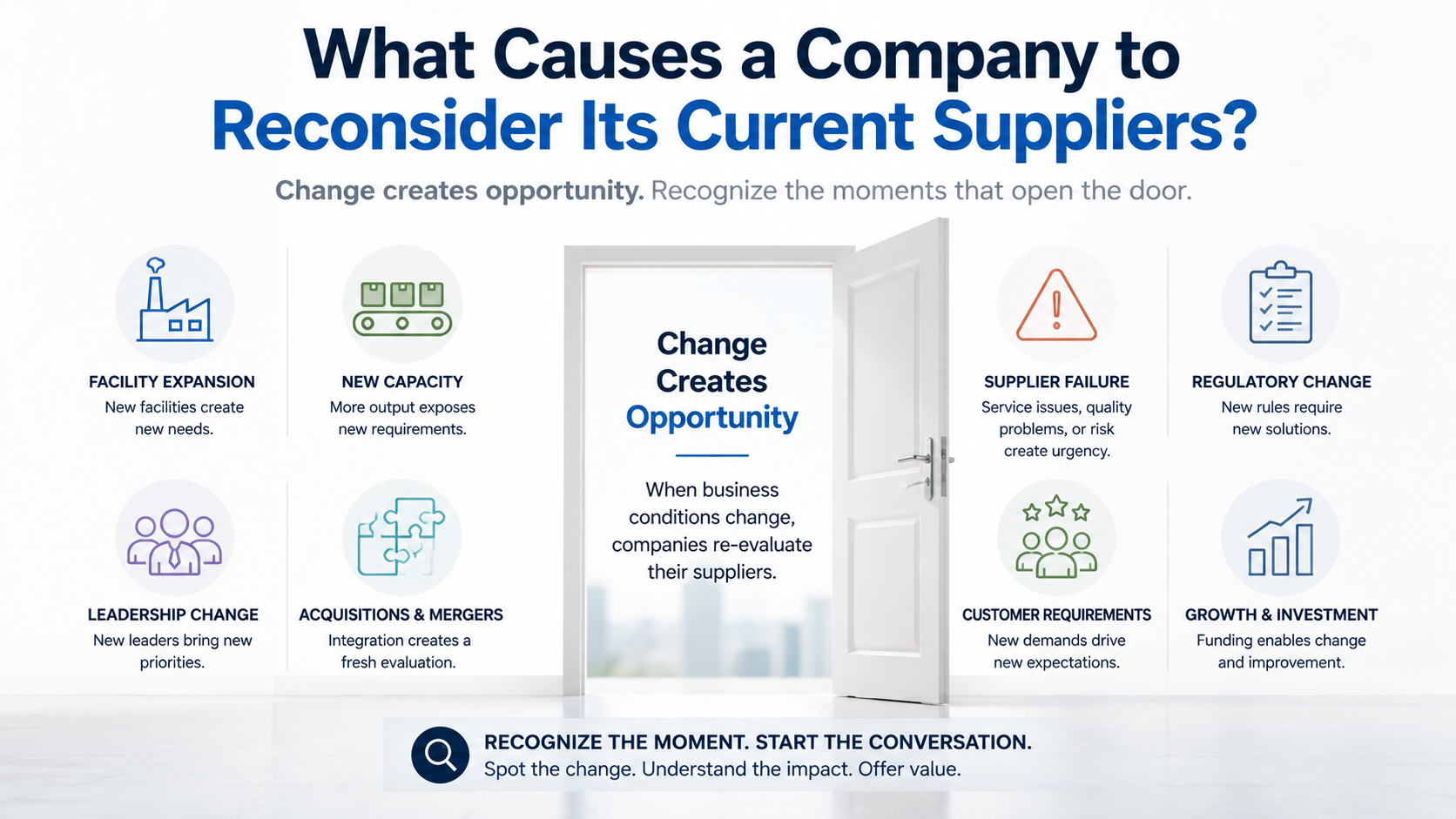
Companies become more willing to reconsider suppliers when something changes inside or around the business.
The change may create a new requirement. It may expose a weakness that was previously manageable. It may increase the cost of doing nothing. It may introduce new leadership with different expectations.
The change creates movement.
That movement can turn a company that had no reason to speak with a salesperson into one that is actively searching for answers.
The strongest sales opportunities often begin with these moments.
Facility Expansion
A company opening, expanding, or relocating a facility may need more than additional space.
It may require new equipment, systems, contractors, materials, logistics support, technology, safety procedures, or professional services.
Existing suppliers may not have the capacity or geographic reach to support the new operation.
The expansion may also give leadership an opportunity to improve processes rather than simply duplicate what already exists.
A company that was not interested in reviewing suppliers last year may become highly receptive when planning a new facility.
The reason is simple: the company is already making decisions.
New Production Capacity
Manufacturers adding a production line, introducing a second shift, or increasing throughput often encounter new operational problems.
Equipment that performed adequately at a lower volume may become a bottleneck. Maintenance requirements may increase. Quality-control systems may need to improve. Packaging, automation, testing, staffing, or material-handling needs may change.
Capacity growth can expose limitations that were easy to tolerate before.
The company may not be looking for a different supplier in general.
It may be looking for a supplier capable of helping it manage a new level of complexity.
Leadership Changes
A new executive rarely arrives with complete loyalty to every existing vendor, process, or assumption.
New leaders are often expected to improve performance.
They review costs, evaluate risks, question existing relationships, and compare current practices with those they used elsewhere.
A new vice president of operations may reassess production systems. A new sales leader may replace prospecting tools. A new chief financial officer may review major contracts. A new plant manager may evaluate maintenance providers and equipment vendors.
The change in leadership does not guarantee that suppliers will be replaced.
It does create a period when established decisions are more likely to be reviewed.
Acquisitions and Mergers
An acquisition can trigger a broad examination of how both organizations operate.
Leadership may consolidate suppliers, standardize systems, combine purchasing, close overlapping facilities, or expand into new markets.
The acquiring company may bring preferred vendors into the purchased business. The acquired company may possess stronger capabilities that are adopted across the larger organization.
Either way, the previous status quo is disrupted.
Suppliers that understand the operational and organizational effects of the acquisition may find opportunities well beyond the initial transaction.
New Products and Markets
Launching a new product can create requirements that did not previously exist.
The company may need different materials, packaging, testing, compliance support, production methods, distribution, marketing, or technical expertise.
Entering a new market can have similar effects.
A company selling into a regulated industry may need additional certifications. International expansion may require new logistics partners. A move into higher-volume retail may place new pressure on production and fulfillment.
The company’s existing suppliers may be capable of supporting the change.
But the launch creates a logical reason to evaluate whether they are still the best fit.
Growth Funding and Capital Investment
When a company receives funding, secures financing, or announces a major capital program, it gains the ability to act on priorities that may have been delayed.
The money may support expansion, hiring, acquisitions, technology, equipment, product development, or market entry.
Funding is not the same as an immediate purchase.
It is evidence that the organization may be moving from intention to execution.
For sales teams, the important question is not simply how much money was raised.
It is what the company plans to change with it.
Supplier Failure
Sometimes the event is not growth.
It is failure.
A supplier misses delivery dates. Product quality declines. Service deteriorates. Prices rise unexpectedly. A critical component becomes unavailable. A vendor is acquired, closes a location, or changes its strategic direction.
The customer may have tolerated smaller problems for years.
A significant failure can suddenly change the calculation.
The risk of switching becomes less important than the risk of staying.
These opportunities can develop quickly, especially when the customer’s own operations or customer relationships are threatened.
Regulatory and Compliance Changes
New regulations can force companies to act even when they would prefer not to.
They may need to change materials, document processes, upgrade equipment, improve cybersecurity, alter reporting, retrain employees, or meet new environmental and safety requirements.
Existing suppliers may not have the expertise or compliant products required.
Regulatory change creates both urgency and a deadline.
That can shorten the buying window and make informed, credible outreach much more valuable.
Large Customer Requirements
A company’s customers can also force change.
A major customer may demand higher capacity, shorter lead times, new certifications, domestic sourcing, improved cybersecurity, different packaging, or more rigorous quality standards.
Winning a large contract may create immediate operational pressure.
Losing one may force cost reductions, restructuring, or entry into new markets.
In either case, the company’s priorities shift.
A supplier that understands what the company is being asked to deliver can approach the conversation from the customer’s business problem rather than from a generic product pitch.
Operational Problems Becoming Visible
Some changes are less dramatic but still important.
A company begins hiring heavily in maintenance. Product complaints increase. Delivery times lengthen. A facility experiences repeated downtime. Job postings reveal a shortage of internal expertise. Leadership discusses margin pressure or capacity constraints.
These developments may indicate that an existing problem has become difficult to ignore.
The company may not have announced a formal buying initiative.
It may be entering the stage where leadership is beginning to define the problem.
That can be an especially valuable time for a knowledgeable supplier to become involved.
Not Every Change Creates an Opportunity
A business event should not be treated as proof that a company is ready to buy.
An expansion may use an existing supplier. A leadership change may produce no vendor review. An acquisition may reduce spending rather than increase it. A job posting may simply replace someone who left.
The event is a reason to investigate, not a reason to assume.
A useful sales process asks:
What specifically changed?
Which part of the business is affected?
What new requirements could result?
Does our company have a relevant capability?
Is there a reasonable person to contact?
Can we begin the conversation with useful context?
This keeps the outreach grounded in the prospect’s circumstances.
The Best Sales Conversations Usually Have a Business Reason
Generic prospecting begins with the seller.
“We provide…”
“We specialize in…”
“We would like to introduce…”
“Do you have any upcoming needs?”
Change-based prospecting begins with the buyer.
“I saw that you are expanding…”
“I noticed that you recently hired…”
“Your new product announcement may create…”
“The acquisition appears to give you…”
“The new requirement could affect…”
The first approach asks the prospect to find a reason to care.
The second begins with a reason that may already exist.
Recognizing the Moment
Companies rarely reconsider established suppliers because a salesperson happens to call.
They reconsider because growth, risk, leadership, technology, customer demands, or operating conditions have changed.
The salesperson’s opportunity is to recognize that moment and approach it intelligently.
That does not remove the need for credibility, persistence, discovery, and strong selling.
It creates a more promising place to begin.
The next challenge is understanding what it costs a sales organization when too much of its prospecting effort is directed toward companies that have no current reason to listen.