Most B2B sales teams know how to identify companies that look like good customers.
They use industry, revenue, geography, employee count, facilities, equipment, applications, and job titles to define the market.
That tells the team where opportunity could exist.
It does not reveal when opportunity may be developing.
A company can match the Ideal Customer Profile perfectly and remain satisfied with its current suppliers for years. Another company with nearly identical characteristics may suddenly become highly receptive because something inside the business has changed.
That visible evidence of movement is a signal of change.
A Practical Definition
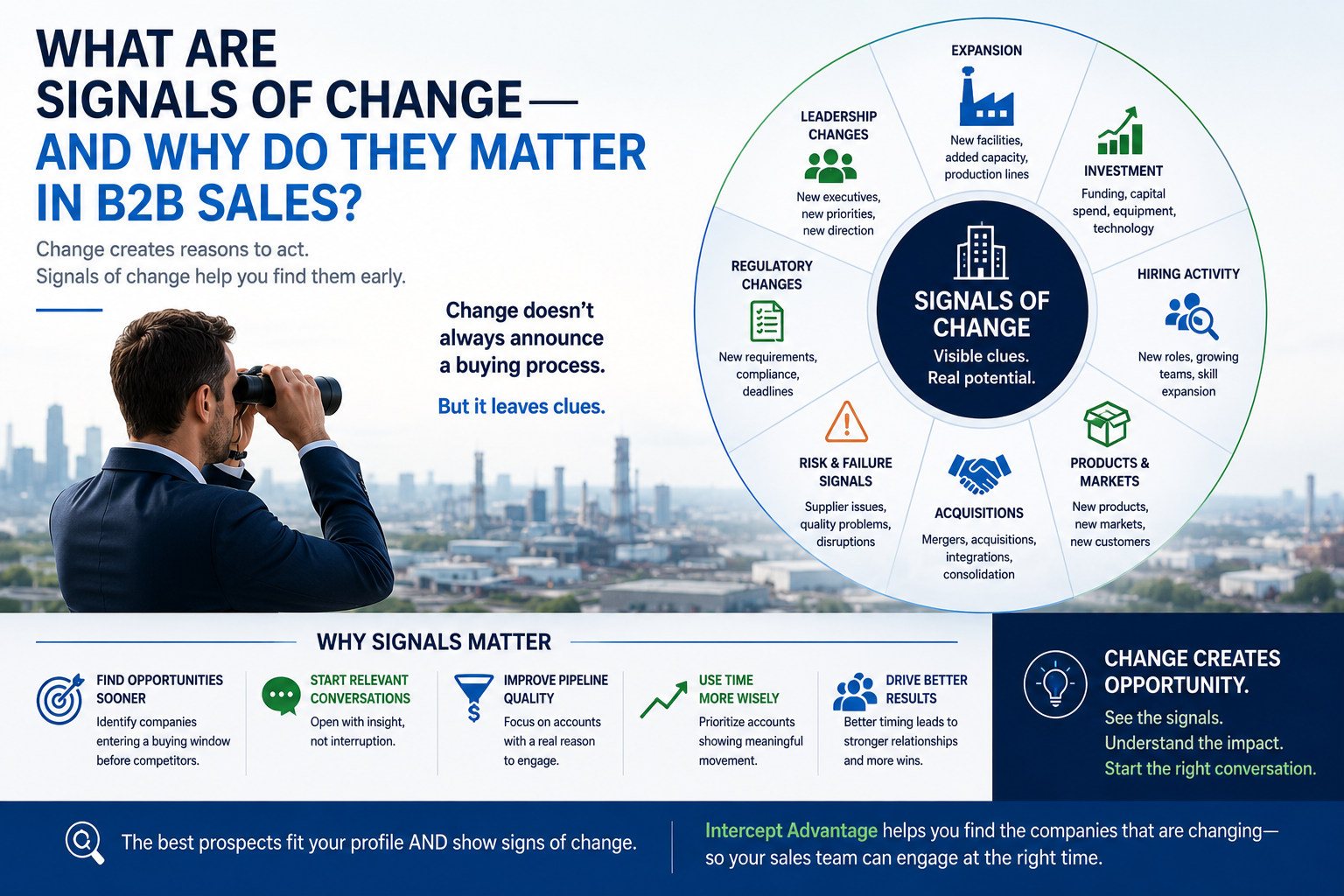
A signal of change is a business development that suggests a company’s priorities, needs, risks, budget, capacity, or operating requirements may be changing.
Common examples include:
Opening or expanding a facility
Adding a production line
Hiring a new executive
Acquiring another company
Receiving growth funding
Launching a new product
Entering a new market
Increasing hiring
Facing a regulatory change
Experiencing supplier or quality problems
A signal does not prove that the company will buy.
It provides a credible reason to investigate.
That distinction is important.
The goal is not to treat every announcement as a sales opportunity. The goal is to recognize developments that may make a sales conversation more timely and relevant.
Signals Reveal Movement
Most traditional account data describes what a company is.
A company is a manufacturer. It has $100 million in revenue. It employs 500 people. It operates three facilities. It uses a certain type of equipment.
Signals describe what the company is doing.
It is expanding. Hiring. Acquiring. Investing. Launching. Reorganizing. Replacing. Entering. Upgrading.
That difference matters because buying decisions are usually connected to movement.
A stable company may continue using the same suppliers and processes even when better alternatives exist. A company undergoing change may be forced to reconsider how it operates.
Signals help reveal that movement before a formal purchasing process becomes obvious.
Expansion Signals
Expansion is one of the clearest categories of change.
A company may:
Build a facility
Lease additional space
Expand an existing plant
Add warehouse capacity
Open a regional office
Increase production
Add a new shift
Install another production line
These developments often create new requirements.
The company may need equipment, components, engineering support, contractors, automation, logistics, technology, staffing, testing, maintenance, or professional services.
An expansion announcement does not identify every resulting purchase.
It tells the sales team that the company is already making decisions and allocating resources.
That makes the account worth examining.
Leadership Signals
Leadership changes can create periods of reassessment.
A company may hire a new:
Chief executive officer
Chief operating officer
Vice president of sales
Vice president of operations
Plant manager
Chief financial officer
Engineering leader
Purchasing executive
New leaders are often expected to improve performance.
They may review suppliers, processes, systems, contracts, costs, risks, and organizational priorities.
Some maintain the existing approach. Others bring preferred vendors and methods from previous roles.
Either way, a leadership transition can create a window during which established decisions become less permanent.
Investment Signals
Capital investment shows that a company may be moving from planning to execution.
Signals may include:
New funding
Capital expenditure announcements
Equipment purchases
Facility improvements
Technology upgrades
Infrastructure projects
Research and development investments
Government grants or incentives
The important question is not simply whether money is available.
It is what the company intends to accomplish with it.
A funding announcement may lead to hiring, expansion, acquisitions, product development, or process improvements. Each creates different possible needs.
Hiring Signals
Job postings can reveal company priorities before formal announcements appear.
A company hiring production workers may be increasing capacity. A search for engineers may indicate a new product, equipment installation, or technical initiative. Multiple maintenance openings may suggest operational strain.
Useful hiring patterns may include:
Rapid growth in open positions
New types of technical roles
Hiring in a new geography
Creation of a new department
Repeated openings in operations or maintenance
Senior leadership recruitment
Roles associated with a new technology or market
A single posting may mean very little.
A pattern of hiring can reveal where the company is investing and what it is trying to build.
Product and Market Signals
A company launching a product or entering a new market may face requirements that did not previously exist.
The business may need:
New materials
Different components
Additional production capacity
Specialized packaging
Certifications
Testing
Distribution support
Marketing capabilities
Technical expertise
New suppliers
Product announcements are often presented as marketing news.
For a sales team, they can also be evidence of operational change.
The most useful question is:
What must the company do differently to make this launch successful?
Acquisition Signals
Mergers and acquisitions can disrupt supplier relationships across both organizations.
Leadership may:
Consolidate purchasing
Standardize systems
Combine facilities
Replace overlapping suppliers
Expand into new geographies
Integrate technology
Increase capacity
Restructure operations
An acquisition can create opportunities and threats.
The acquiring company may expand an existing supplier relationship across the new organization. It may also eliminate vendors that no longer fit the combined strategy.
The signal deserves investigation because the previous operating model is unlikely to remain completely unchanged.
Risk and Failure Signals
Not every useful signal is positive.
Problems can create strong reasons to consider new solutions.
Examples include:
Supplier disruptions
Product recalls
Quality failures
Delivery delays
Equipment downtime
Cybersecurity incidents
Regulatory violations
Customer complaints
Material shortages
Rising operating costs
These events can quickly increase urgency.
A company that tolerated an inefficient supplier for years may act immediately when the problem threatens production, customers, safety, or compliance.
Risk signals must be handled carefully.
The outreach should be useful and informed, not opportunistic or insensitive.
Regulatory Signals
New laws, standards, certifications, and customer requirements can force companies to change.
A business may need to:
Replace materials
Upgrade equipment
Improve reporting
Document processes
Strengthen cybersecurity
Reduce emissions
Change packaging
Modify workplace procedures
Obtain new certifications
Regulatory developments often include deadlines.
That creates both urgency and a defined period in which the company must evaluate alternatives.
Suppliers with relevant expertise may be especially valuable because buyers are not simply comparing products. They are trying to understand what compliance requires.
Signals Can Be Early or Late
Some signals appear before the buying process begins.
Examples include:
Early hiring
Permit applications
Planning approvals
Executive recruitment
Funding announcements
Preliminary expansion discussions
Others appear after important decisions have already been made.
Examples include:
Ribbon-cutting ceremonies
Completed facility announcements
Equipment already installed
Product launches after production begins
Both are useful, but they create different sales opportunities.
Early signals may allow a supplier to help shape the project.
Late signals may reveal follow-on needs, future expansion, maintenance requirements, or similar activity elsewhere in the company.
Understanding the stage of the change is as important as recognizing the signal itself.
One Signal Is Not Always Enough
A single event may be ambiguous.
A job opening could replace an employee who left. A facility announcement may involve no meaningful operational expansion. A new executive may have no intention of changing suppliers.
Multiple related signals create a stronger case.
For example:
A company receives funding
Announces a facility expansion
Hires an engineering director
Posts several technical positions
Together, those developments suggest a broader initiative.
The sales team can approach the account with greater confidence because the signals reinforce one another.
A Signal Must Be Relevant to What You Sell
Not every change matters to every supplier.
A leadership appointment may be relevant to a consulting firm but unimportant to a component manufacturer.
A new warehouse may create a major opportunity for a material-handling company, but little value for a software provider focused on product development.
The signal must connect to a plausible business need.
A useful evaluation asks:
What changed?
Which part of the business is affected?
What new need, risk, or requirement could result?
Does our company have a relevant capability?
Who would likely be responsible for the issue?
Is there enough context for a credible conversation?
This prevents teams from confusing news volume with opportunity quality.
Signals Improve the Opening Conversation
Generic prospecting usually begins with the seller:
“We provide…”
“We specialize in…”
“I wanted to introduce our company…”
Signal-informed outreach begins with the prospect’s situation:
“I saw that you are adding production capacity…”
“I noticed that you recently hired a new operations leader…”
“Your entry into the medical market may create additional testing requirements…”
“The facility expansion appears likely to increase…”
The salesperson still needs to explain the company’s capabilities.
But the conversation begins with a business reason rather than an unsolicited introduction.
That makes the outreach more relevant and easier for the prospect to evaluate.
Signals Are Evidence, Not Certainty
Signals of change do not eliminate the uncertainty of selling.
Some will produce no opportunity. Some will be misinterpreted. Some companies will use existing suppliers. Others will change direction before acting.
That is not a failure of the method.
The purpose is to improve prioritization, not achieve perfect prediction.
A sales team deciding between two otherwise similar accounts should generally investigate the company showing meaningful movement before the company where nothing appears to be changing.
That is a more informed use of limited sales capacity.
From Static Lists to a Living Market View
Traditional prospect lists are snapshots.
They show a group of companies at a single point in time.
Signals of change create a more dynamic view of the market.
They help the sales team see:
Which target companies are moving
What is changing
Why the change may matter
Which accounts deserve investigation
When outreach may be most relevant
This turns prospecting from a list-processing exercise into an ongoing opportunity-identification process.
The Challenge Is Finding and Interpreting the Signals
Signals are scattered across many sources:
Company websites
Press releases
Local business news
Industry publications
Job postings
Regulatory notices
Permits
Funding announcements
Executive appointments
Trade association updates
Public records
No salesperson can watch all of these sources across an entire market while also managing active opportunities and customers.
The practical challenge is collecting the information, filtering it against the Ideal Customer Profile, interpreting its commercial relevance, and directing the strongest findings to sales.
That is the problem Intercept Advantage is designed to address.
Intercept Advantage monitors target markets for meaningful signals of change, evaluates them against a company’s customer profile and value proposition, and helps sales teams focus on organizations with a credible reason to engage.
The objective is not to replace sales judgment.
It is to give that judgment better information—and a better place to begin.