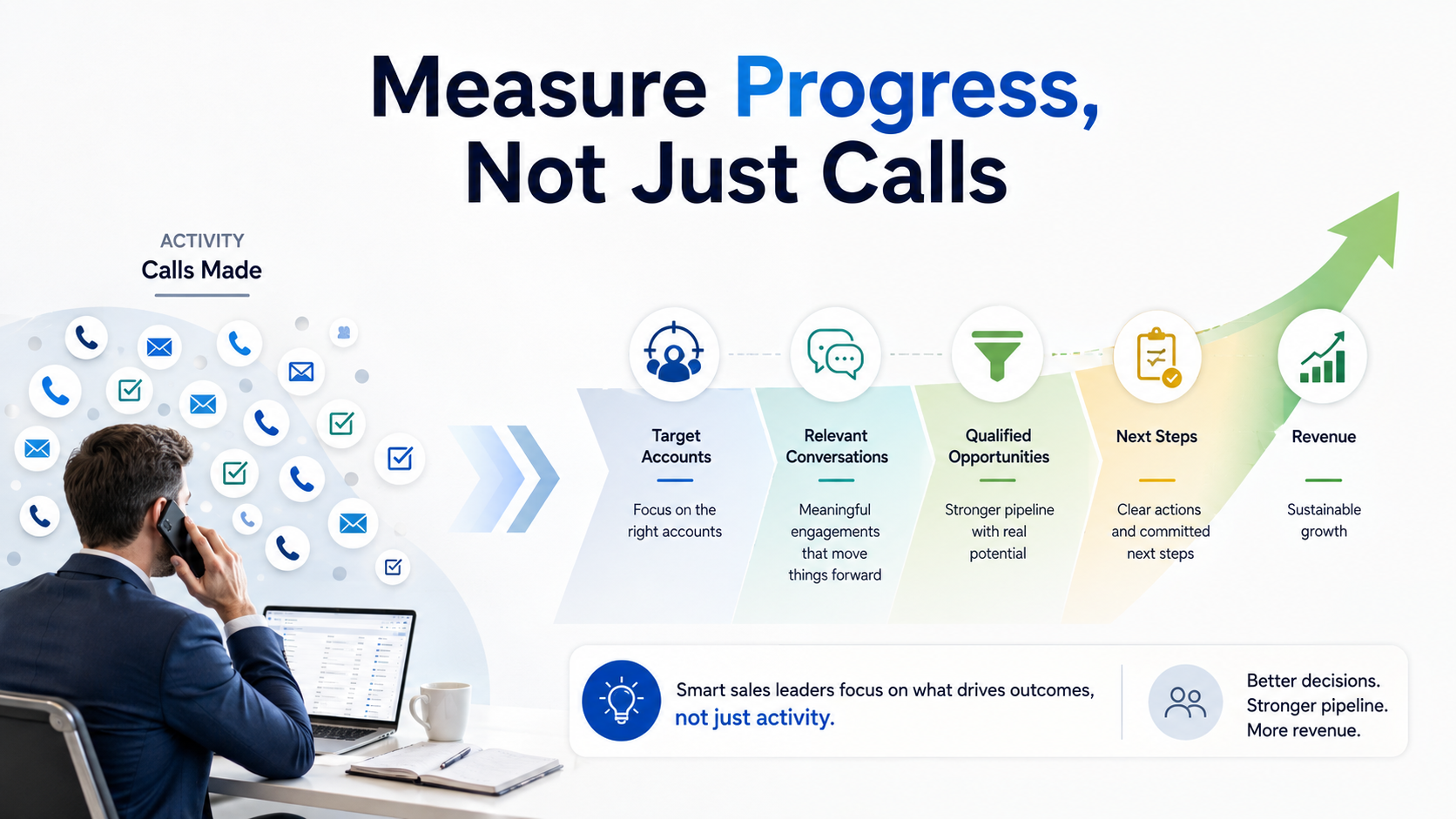
Sales managers need measurable expectations.
Calls, emails, and follow-ups are easy to count, so they often become the primary measure of salesperson productivity.
But activity is not the same as progress.
A salesperson can make 100 calls to poorly selected companies and produce nothing. Another can make 30 calls to well-qualified accounts and create several meaningful conversations.
The first salesperson generated more activity.
The second created more sales value.
Activity Is an Input
Calls and emails are necessary inputs into the sales process.
They show effort and consistency. They can also reveal when a salesperson is avoiding prospecting or failing to follow up.
But call volume alone does not tell management:
Whether the right companies were contacted
Whether decision-makers were reached
Whether useful conversations occurred
Whether prospects agreed to next steps
Whether opportunities advanced
Whether revenue became more likely
Activity should be measured, but it should not be confused with performance.
Volume Metrics Shape Behavior
Salespeople adapt to what management measures.
When the main goal is hitting a call target, representatives may rush through lists, contact weak-fit companies, minimize research, and favor easy activity over important accounts.
That does not necessarily mean they are performing poorly.
They may simply be doing exactly what the scorecard rewards.
If management measures only volume, the team will optimize for volume.
Measure What the Activity Produced
The better question is not simply:
How many calls did you make?
It is:
What did those calls produce?
A more useful sales scorecard should track:
Focus
Priority accounts investigated
High-fit prospects contacted
New opportunities acted on promptly
Engagement
Relevant conversations started
Decision-makers reached
Meetings secured
Progress
Qualified opportunities created
Next steps agreed upon
Opportunities advanced
Pipeline integrity
Stalled deals reviewed
Weak opportunities removed
Close dates validated
Results
Proposals
Wins
Revenue
Conversion rates
This gives management a clearer picture of both effort and effectiveness.
Relevant Conversations Matter More Than Dials
A conversation should not count simply because someone answered the phone.
A useful sales conversation confirms something important:
The business issue is real
The project exists
The timing is plausible
The contact is involved
Another stakeholder should participate
A specific next step makes sense
That is much closer to revenue progress than another completed call.
Track Buyer Movement
Salespeople can be highly active while opportunities remain stalled.
They may send emails, leave messages, prepare information, and update the CRM. None of that proves the buyer is moving.
Real advancement occurs when the prospect participates:
Requirements are shared
Another decision-maker joins
A technical review is scheduled
A proposal is requested
A decision date is confirmed
Sales management should therefore measure buyer movement, not just seller activity.
Reward Pipeline Honesty
Salespeople are often rewarded for adding opportunities but not for removing weak ones.
That encourages inflated pipelines.
Closing an inactive or poorly qualified deal is not failure. It improves forecast accuracy and allows the salesperson to focus on stronger opportunities.
A clean pipeline is more valuable than a large pipeline filled with hope.
Keep Activity Standards—But Put Them in Context
Call and email expectations still have value.
A salesperson who performs very little outreach is unlikely to create enough conversations.
The mistake is using activity as the only measure.
A balanced approach asks:
Did the salesperson put in enough effort?
Was that effort aimed at the right accounts?
Did it produce engagement?
Did opportunities move?
Did revenue become more likely?
That is a much better management conversation.
AI Can Improve Sales Focus
AI can help sales teams spend less time deciding whom to contact and more time conducting useful outreach.
It can help identify strong-fit companies, monitor signals of change, summarize account developments, prioritize prospects, and prepare first-pass outreach.
Intercept Advantage supports that process by helping sales teams focus on companies showing both customer fit and evidence of movement.
The objective is not simply more calls.
It is more calls to the right companies, at the right time, with a stronger reason to engage.
Measure What You Actually Want
Most companies do not really want more activity.
They want:
Better conversations
Stronger opportunities
Faster pipeline movement
More wins
More revenue
Call volume can contribute to those outcomes.
It should never be mistaken for them.