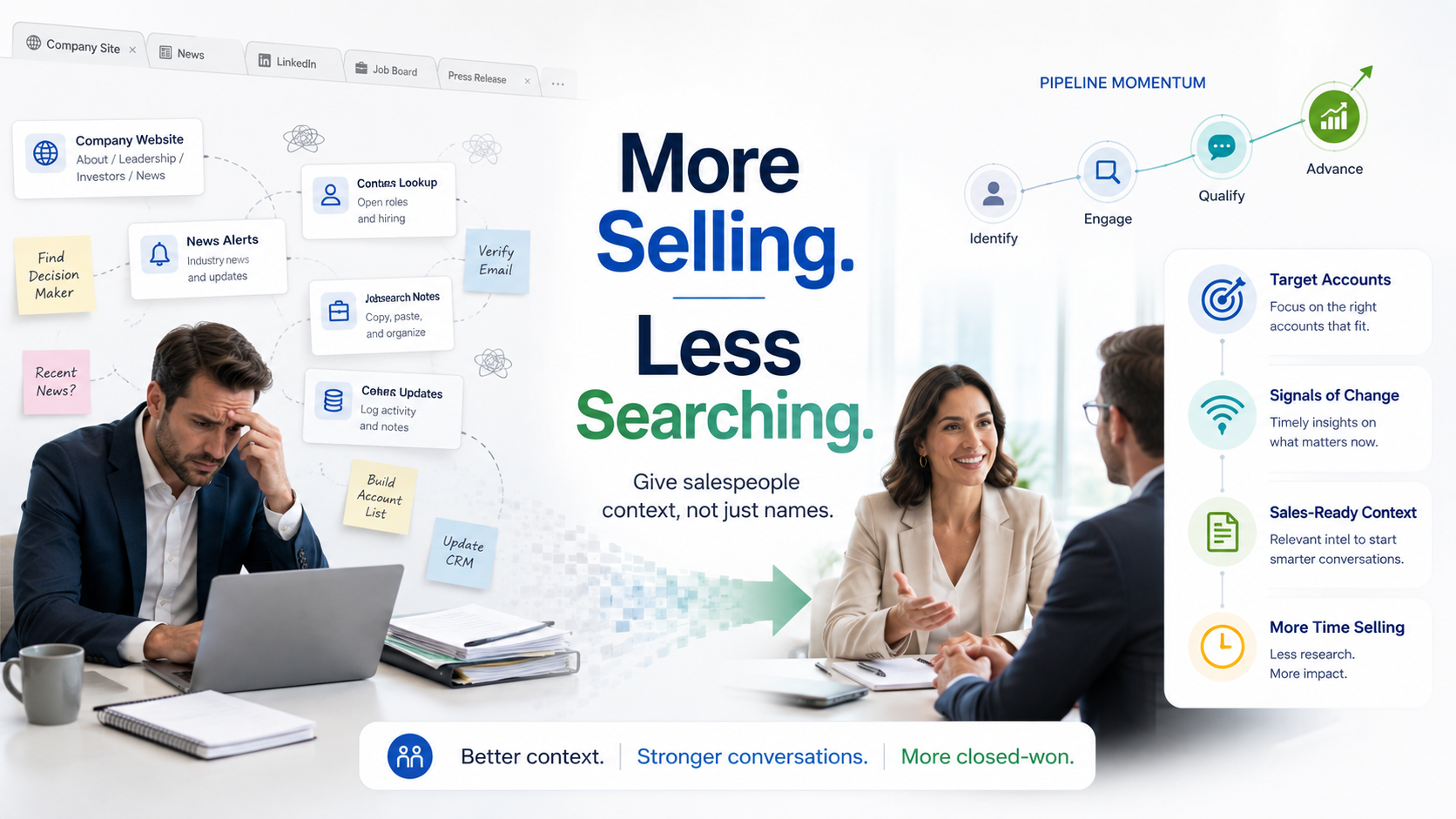
Blog 6 Publishing Package
Title: Salespeople Should Spend More Time Selling—and Less Time Searching
URL slug:salespeople-should-spend-more-time-selling
Meta description:
Salespeople lose valuable selling time researching accounts, finding contacts, and sorting information. Learn how better sales intelligence can return that time to selling.
Salespeople are hired to sell.
Yet a surprising amount of their day can disappear into work that happens before selling begins.
Finding companies. Researching websites. Searching LinkedIn. Looking for decision-makers. Reading news. Checking job postings. Reviewing alerts. Trying to understand why an account might be worth contacting.
All of that work can be necessary.
But there is an important management question:
How much of it should your salesperson really be doing?
The Hidden Cost of Sales Research
Suppose a salesperson spends 20 minutes researching a company before deciding whether it deserves outreach.
That does not sound excessive.
But research 15 companies and five hours are gone.
And the salesperson has not yet spoken with a prospect.
Multiply that across a sales team, and the cost becomes substantial.
Research is valuable when it produces better sales conversations. It becomes expensive when salespeople spend hours researching companies that ultimately have no current reason to buy.
The Blank-Screen Problem
Many salespeople begin prospecting with almost nothing but a company name.
From there they must determine:
Does this company actually fit?
What does it do?
Has anything important changed?
Is there a project underway?
Who should I contact?
What does that person care about?
Why should I reach out now?
Only after answering those questions can the salesperson begin writing an email or making a call.
That is a lot of work before the actual selling starts.
Give Salespeople Context, Not Just Names
A prospect list is useful.
A prospect list with sales-ready context is much more useful.
Imagine receiving an account that already includes:
Company: The target organization
Why it fits: Relevant ICP characteristics
What changed: Expansion, hiring, funding, new leadership, acquisition, etc.
Why it matters: The likely commercial implication
Contacts: People most likely involved
Timing: How recently the change occurred
Source: Where the information came from
Now the salesperson begins from a very different position.
Instead of spending 20 minutes trying to discover why the company matters, the salesperson spends those 20 minutes deciding how best to approach it.
That is a much better use of sales expertise.
Salespeople Still Need to Research
This does not mean eliminating account research.
A salesperson preparing for an important discovery meeting should absolutely investigate the company.
Strategic accounts deserve deeper preparation.
Large opportunities may require an understanding of leadership, competitors, facilities, products, financial performance, and prior interactions.
The goal is not to remove research.
It is to remove unnecessary discovery work at the top of the funnel.
Salespeople should not repeatedly search the internet merely to determine whether an account deserves their attention in the first place.
AI Changes the Economics
This is an area where AI can provide immediate value.
AI can help:
Monitor hundreds or thousands of companies
Summarize new business developments
Compare companies with an Ideal Customer Profile
Identify signals of change
Rank accounts for relevance
Explain possible business implications
Prepare concise account briefs
Draft a first-pass outreach message
Tasks that previously required considerable manual research can now be performed much faster.
But the objective is not simply to automate research.
It is to return time to the salesperson.
Keep Humans Where Humans Matter Most
AI is very good at collecting, filtering, summarizing, and organizing information.
Salespeople are better at:
Asking good questions
Reading the room
Understanding nuance
Building credibility
Developing relationships
Handling objections
Negotiating
Recognizing when something does not quite add up
That is where salespeople create the most value.
A sales organization should use technology to reduce work around those activities—not replace them.
The Better Division of Labor
A more productive sales process looks like this:
Technology and AI: Find and prioritize promising accounts.
Sales intelligence: Explain why each account may deserve attention.
Salesperson: Decide how to engage, conduct discovery, build the relationship, and qualify the opportunity.
That division lets each resource do what it does best.
Intercept Advantage is built around this model: monitoring target markets, identifying signals of change, assessing fit and relevance, and giving salespeople the context they need before outreach begins.
The salesperson still sells.
They just start farther down the field.
Selling Time Is Expensive. Protect It.
Salespeople will always need to prospect.
They will always need to research.
But their highest-value hours should be spent:
Starting conversations
Conducting discovery
Advancing opportunities
Developing relationships
Preparing solutions
Closing business
Not hunting through dozens of websites hoping to discover which company might be worth calling.
The objective is simple:
Let machines do more of the searching so salespeople can do more of the selling.