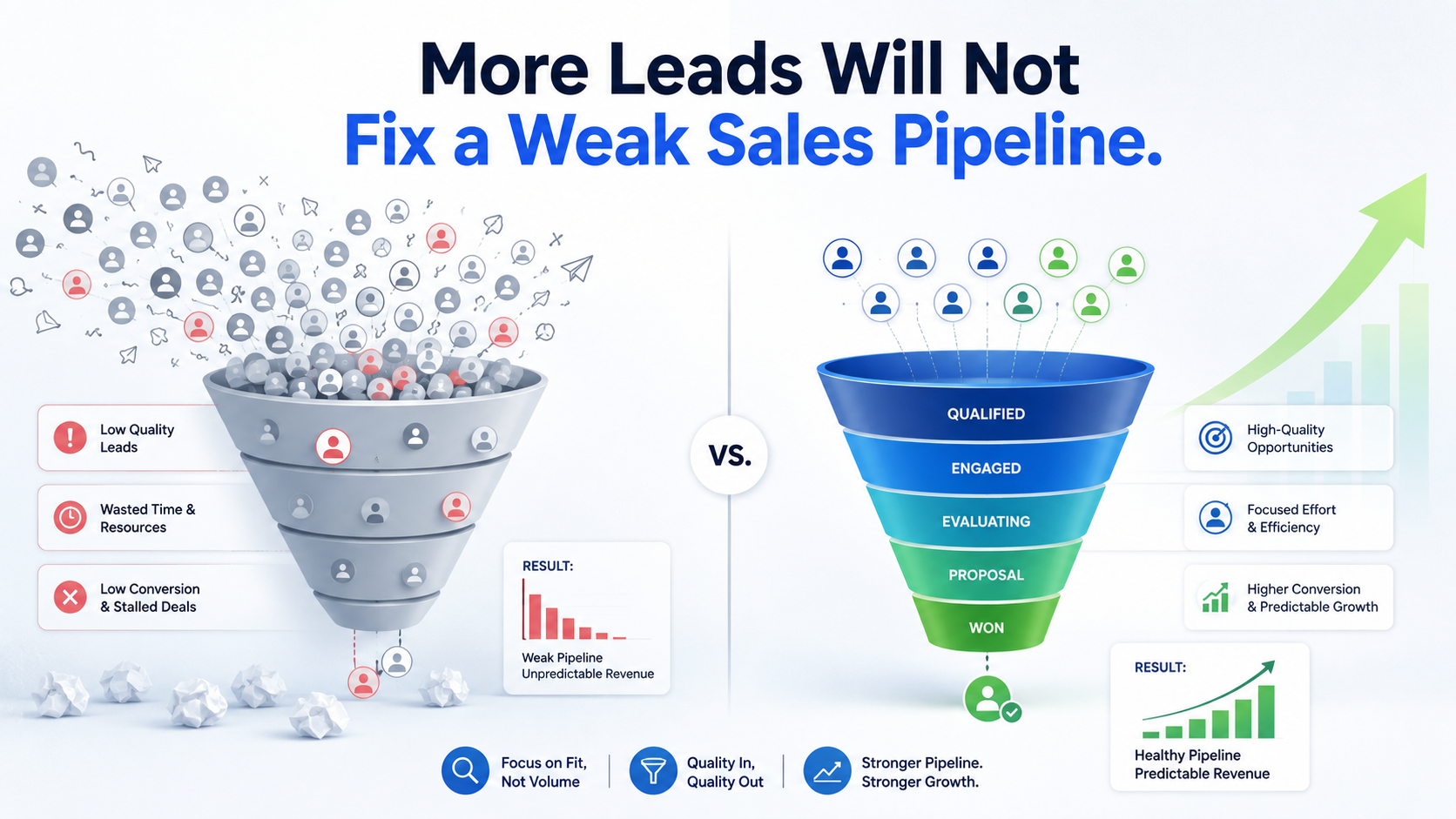
When sales growth slows, the usual response is predictable:
We need more leads.
Marketing increases campaigns. The company buys more contact data. Salespeople receive longer prospect lists. Activity targets rise.
The assumption is that more names entering the top of the funnel will eventually produce more revenue at the bottom.
Sometimes that works.
But when the sales pipeline is already filled with poorly matched, poorly timed, or weakly qualified prospects, adding more leads does not solve the problem.
It makes the problem larger.
Lead Volume and Opportunity Quality Are Different
A lead is simply a person or company that may be worth investigating.
It is not automatically a qualified prospect, and it is certainly not a sales opportunity.
A company may be in the correct industry, have the right revenue, and employ the right decision-maker. But it may also be satisfied with its current supplier, have no approved project, and have no reason to change.
That company may fit the target profile.
It is not necessarily ready for sales attention.
When organizations measure success primarily by the number of leads generated, they can confuse database growth with pipeline growth.
The CRM becomes fuller. Salespeople become busier. Revenue may not improve.
More Leads Create More Work
Every new lead creates a series of tasks.
Someone must:
Verify the company
Confirm that it fits the target market
Find the right contact
Research the account
Write an email
Make a call
Schedule follow-up
Enter activity into the CRM
Decide whether the account should remain active
If the lead has little chance of becoming a customer, that work still consumes time.
A sales team given 5,000 unprioritized names may spend more time sorting, researching, and rejecting accounts than actually speaking with qualified prospects.
The problem is not a lack of activity.
It is poor use of sales capacity.
Weak Leads Inflate the Pipeline
Salespeople are often expected to show pipeline coverage.
That creates pressure to convert early interest into formal opportunities.
A prospect who accepts a meeting may enter the pipeline. A company that requests information may receive an estimated value. An account with vague future interest may remain open for months.
The result is a pipeline that looks larger than it really is.
Common symptoms include:
No defined business problem
No compelling reason to act
No internal sponsor
No decision process
No budget discussion
Close dates that repeatedly move
Long periods without meaningful progress
A large pipeline filled with weak opportunities does not protect the forecast.
It makes the forecast less reliable.
The Real Question Is Why the Prospect Might Buy
Lead generation usually answers:
Who could buy from us?
A stronger opportunity-identification process also asks:
Why might this company consider buying now?
That reason could be:
Facility expansion
New leadership
Capacity pressure
A product launch
Capital investment
Regulatory change
Supplier failure
Rapid hiring
Acquisition activity
A major customer requirement
These developments do not guarantee a sale.
They give the sales team a credible reason to investigate.
A company that fits the Ideal Customer Profile and is showing evidence of meaningful change is usually more valuable than a similar company where nothing appears to be happening.
Better Qualification Improves Sales Execution
Sales execution becomes easier when the salesperson begins with a relevant account.
The opening conversation can focus on the prospect’s situation rather than a generic company introduction.
Instead of saying:
We provide solutions that help companies improve productivity.
The salesperson can say:
I saw that you are adding a second production line. Companies at that stage often encounter capacity, integration, and maintenance issues before the new line is fully operational.
The second message does not guarantee a response.
It gives the prospect a clearer reason to listen.
Better inputs allow salespeople to use their selling skills where those skills have a greater chance of producing revenue.
Sales Managers Should Measure Quality as Well as Volume
Lead counts remain useful, but they should not stand alone.
Sales management should also examine:
How many leads fit the Ideal Customer Profile?
How many show a credible reason to engage?
How many produce relevant conversations?
How many become genuinely qualified opportunities?
How many advance to the next defined step?
How many stalled opportunities are removed?
Which sources produce revenue rather than activity?
These questions reveal whether the sales process is creating momentum or merely processing names.
A smaller number of well-selected accounts may produce more useful conversations than a large volume of lightly qualified leads.
AI Can Help Reduce the Sorting Burden
Artificial intelligence is useful when it helps sales teams evaluate large amounts of information more efficiently.
AI can assist with:
Comparing companies to the Ideal Customer Profile
Summarizing company developments
Classifying signals of change
Identifying possible business implications
Prioritizing accounts
Preparing account briefs
Drafting initial outreach
AI should not decide on its own that a company will buy.
It should reduce the time salespeople spend searching, sorting, and summarizing so they can spend more time applying judgment and speaking with prospects.
The value is not simply automation.
It is better allocation of human attention.
The Goal Is Not Fewer Opportunities
The goal is not to make the pipeline artificially small.
It is to ensure that what enters the pipeline deserves to be there.
A healthy growth process should:
Define the right companies.
Identify which of those companies are changing.
Evaluate whether the change may create a relevant need.
Prioritize the strongest accounts.
Give salespeople useful context.
Qualify opportunities honestly.
Remove deals that are not progressing.
This creates a pipeline built on evidence rather than hope.
Better Leads Begin With Better Intelligence
Most sales teams do not need an unlimited supply of names.
They need a manageable number of companies that fit the market, show signs of movement, and have a plausible reason to engage.
That is the role Intercept Advantage is designed to support.
Intercept Advantage monitors target markets, identifies meaningful signals of change, evaluates their relevance, and helps sales teams focus on companies more likely to be entering a buying window.
More leads can create more activity.
Better opportunity intelligence creates a better chance of growth.