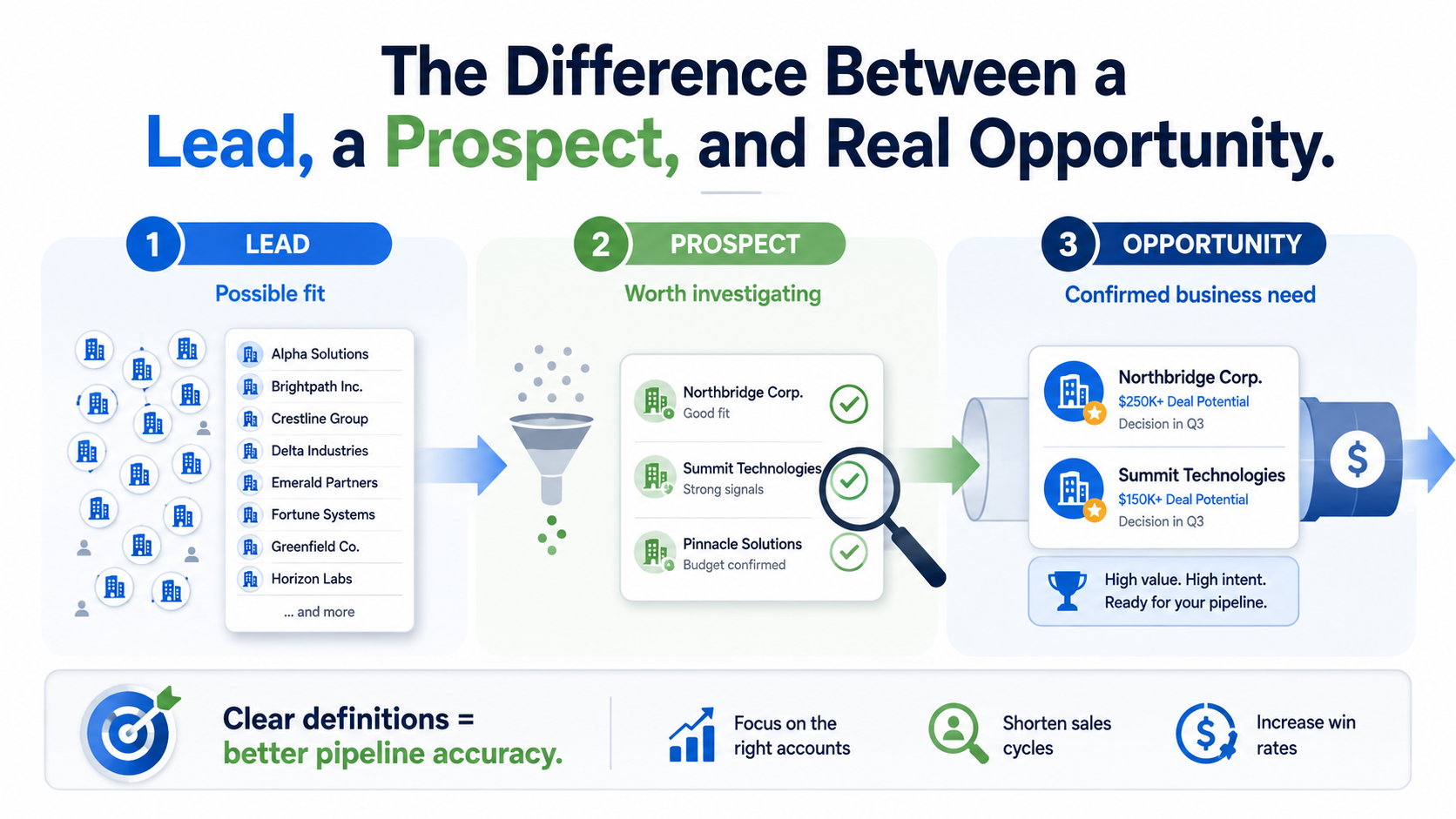
Sales teams often use the words lead, prospect, and opportunity as though they mean the same thing.
They do not.
When those terms are poorly defined, the CRM fills with accounts that look more promising than they really are. Pipeline reports become inflated. Forecasts become unreliable. Salespeople spend too much time following up with companies that have never entered a legitimate buying process.
Clear definitions make sales management much easier.
A Lead Is a Possible Fit
A lead is a person or company that may be worth investigating.
The company might:
Operate in the right industry
Match the desired revenue range
Use relevant equipment or technology
Employ the right decision-makers
Fit the target geography
Resemble existing customers
That makes it potentially interesting.
It does not mean the company has a need, a project, a budget, or any intention of changing suppliers.
A purchased contact, trade-show attendee, website visitor, referral name, or company found in a database may all be leads.
A lead answers:
Could this company become a customer?
At this stage, the answer is only “possibly.”
A Prospect Is Worth Active Investigation
A prospect is a lead that has passed an initial qualification test.
The company appears to fit the Ideal Customer Profile, and there is enough evidence to justify sales attention.
That evidence might include:
A meaningful signal of change
A relevant project announcement
A recent leadership appointment
Expansion or investment activity
A response to outreach
A known business issue
A referral from a credible source
A prospect is not yet a confirmed sales opportunity.
But there is a reasonable basis for researching the account, identifying the correct contacts, and beginning a conversation.
A prospect answers:
Is this company worth pursuing now?
An Opportunity Requires Evidence of a Buying Process
A real sales opportunity exists when the salesperson has confirmed that the prospect has a business issue the company may be able to address.
Depending on the complexity of the sale, qualification may include:
A defined need or problem
A reason to act
A likely decision-maker or internal sponsor
A realistic buying process
A plausible budget or funding path
A meaningful next step
A reasonable timeframe
Not every element must be fully known after the first conversation.
But there should be enough evidence that the company is doing more than expressing general interest.
An opportunity answers:
Is there a legitimate business decision we may be able to influence and win?
Why the Distinction Matters
When every lead becomes an opportunity, pipeline coverage looks stronger than it is.
Sales managers may see millions of dollars in potential business, but much of it may consist of companies that:
Have never responded
Have no active project
Are satisfied with current suppliers
Have no internal urgency
Have not identified a decision process
Have no agreed next step
These records are not harmless.
They consume follow-up time, distort forecasts, and make it difficult to see where the real business is.
A smaller pipeline containing legitimate opportunities is more useful than a large pipeline filled with possibilities.
Interest Is Not the Same as Intent
One common mistake is treating polite interest as buying intent.
A prospect may say:
“Send me some information.”
“Keep in touch.”
“We may look at this next year.”
“This is interesting.”
“Call me again in a few months.”
Those responses may justify continued monitoring or light follow-up.
They do not necessarily justify creating a forecasted opportunity.
The key question is whether the prospect has agreed to move the evaluation forward.
Examples of meaningful movement include:
Scheduling a discovery meeting
Introducing another decision-maker
Sharing project requirements
Discussing timing
Requesting a proposal
Agreeing to a specific next step
Without movement, the account may remain a prospect rather than an opportunity.
Use Different Management Actions for Each Stage
Each category should trigger a different response.
Lead
Confirm whether the company fits the target profile.
Action: Research, score, enrich, or dismiss.
Prospect
Determine whether there is a relevant reason to engage.
Action: Contact, investigate, monitor, and qualify.
Opportunity
Manage an active buying process.
Action: Conduct discovery, develop the solution, secure next steps, and advance the decision.
This prevents salespeople from applying expensive opportunity-management effort to accounts that have not earned it.
Signals of Change Improve the Transition
Signals of change can help determine which leads deserve promotion to prospect status.
A company announcing an expansion, acquisition, leadership change, new product, funding event, or regulatory challenge may have a stronger reason to engage than a similar company where nothing appears to be happening.
The signal does not create an opportunity by itself.
It creates a reason to investigate.
Sales still needs to confirm whether the development connects to a real need.
AI Can Help With Early Qualification
AI can reduce the manual work required to distinguish leads from promising prospects.
It can help:
Compare companies with the Ideal Customer Profile
Summarize recent business developments
Identify signals of change
Explain possible commercial implications
Rank accounts for investigation
Prepare concise account briefs
Human judgment remains necessary before an account becomes a real opportunity.
The purpose of AI is to help salespeople spend less time sorting names and more time qualifying the companies most likely to matter.
Pipeline Integrity Starts With Definitions
A disciplined sales organization should be able to explain why every record is in its current stage.
A lead should not become a prospect merely because someone found a contact.
A prospect should not become an opportunity merely because an email was sent.
An opportunity should represent a business issue, a plausible decision process, and meaningful forward movement.
Intercept Advantage helps companies identify and prioritize strong prospects by combining customer fit with signals of change.
The salesperson then confirms whether a real opportunity exists.
That division is important:
Intelligence identifies where to look. Sales qualification determines what belongs in the pipeline.