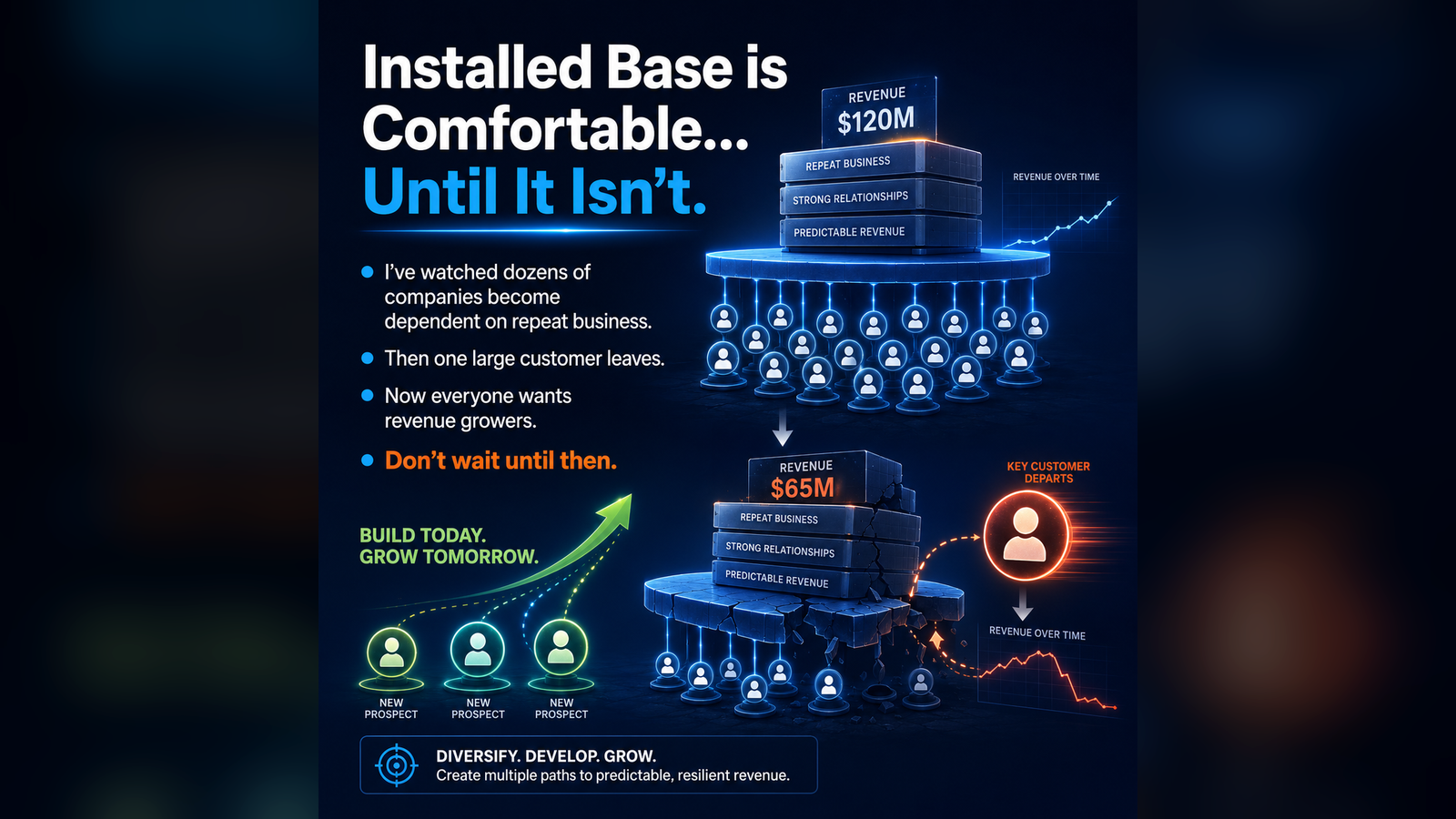
Repeat business is one of the best things that can happen to a company.
Existing customers know you. Your team understands their needs. Sales cycles are shorter. Delivery becomes more efficient. Revenue feels predictable.
Over time, that stability becomes comfortable.
Sometimes too comfortable.
I have watched many companies become heavily dependent on their installed base. The business looks healthy, revenue appears dependable, and leadership assumes the customer relationships are secure.
Then one large customer leaves.
Suddenly, the same company that was satisfied with repeat business is scrambling for new revenue.
The problem is not that the installed base was bad. The problem is that it became the entire growth strategy.
Repeat Business Can Hide Revenue Risk
A strong installed base often creates the appearance of a resilient company.
Revenue is steady. Relationships are strong. Forecasting is easier. Salespeople stay busy servicing existing accounts.
But beneath that stability, customer concentration may be increasing.
One large customer may represent a meaningful share of revenue. Several long-term accounts may be tied to the same industry, geographic market, ownership group, or economic cycle.
As long as those customers remain, the risk is easy to ignore.
That changes quickly when a major account is lost because of:
A merger or acquisition
A leadership change
A supplier consolidation initiative
A budget reduction
A facility closure
A shift in strategic direction
A competitor offering a lower price
A decision to bring the work in-house
The revenue decline can be immediate. Replacing it rarely is.
Strong Relationships Are Not the Same as Permanent Relationships
Companies often believe long-standing relationships will protect them.
They may. But relationships are only one factor in a purchasing decision.
Your day-to-day contact can be replaced. A new executive can arrive with preferred suppliers. Procurement can mandate a competitive bid. Private equity ownership can force consolidation. A customer can simply outgrow your current offering.
None of these outcomes necessarily means you failed.
They mean the customer’s situation changed.
That is why relying on relationship strength alone is dangerous. A strong relationship can improve retention, but it does not eliminate strategic, financial, or organizational risk.
Every customer relationship eventually faces change.
Why Companies Wait Too Long to Build New Pipeline
When repeat business is strong, new business development feels less urgent.
Leadership may say:
“We are already at capacity.”
“Our customers keep sending us work.”
“We do not need another salesperson.”
“Let’s focus on taking care of what we already have.”
“We can turn on marketing later if things slow down.”
That last assumption causes the most trouble.
New business development is not a switch that produces immediate revenue.
It takes time to identify the right companies, understand their needs, build awareness, establish credibility, start conversations, qualify opportunities, and move deals through the pipeline.
Waiting until revenue drops means beginning the process at the exact moment the company can least afford to wait.
A Revenue Gap Is Easier to Prevent Than Replace
Imagine a company generating $120 million in annual revenue. A large customer leaves, and revenue falls to $65 million.
The loss may happen quickly. Rebuilding the missing $55 million could take years.
The company now faces pressure from every direction:
Salespeople are told to find business immediately
Marketing is expected to produce leads quickly
Pricing becomes more aggressive
Poor-fit opportunities receive too much attention
Leadership begins chasing large deals with low probability
Forecasts become less reliable
Employee confidence declines
The organization becomes reactive.
That reaction is understandable, but it is also preventable.
A company that consistently develops new relationships and identifies emerging opportunities is far less vulnerable when a major customer departs.
Installed-Base Management and Growth Are Different Jobs
Serving existing customers and developing new customers require different disciplines.
Installed-base management focuses on retention, satisfaction, service, delivery, and account expansion.
New business development focuses on identifying change, opening relationships, creating relevance, and establishing credibility before an urgent need appears.
Both matter.
The mistake is assuming that account management will automatically produce enough new growth.
Expansion revenue from existing customers is valuable, but it does not create diversification. In some cases, it increases concentration by making the company even more dependent on the same accounts.
True resilience requires multiple paths to revenue.
Diversification Must Be Built Before It Is Needed
Revenue diversification does not mean pursuing every possible market.
It means deliberately creating a broader and healthier mix of customers, opportunities, and revenue sources.
That may involve:
Developing new accounts within the current industry
Entering adjacent markets where your capabilities apply
Expanding into new geographic territories
Reaching different buyer groups
Introducing complementary services
Reducing dependence on one dominant customer
Building relationships with companies showing early buying signals
The objective is not random expansion.
It is controlled risk reduction.
A diversified pipeline gives the company choices. It prevents one customer’s decision from determining the company’s future.
The Right Time to Develop New Business Is When Business Is Good
The best time to invest in growth is not after a customer leaves.
It is when revenue is stable, margins are healthy, and the company can be selective.
That is when you can pursue the right opportunities rather than accepting whatever appears.
You can research the market properly. You can identify companies that fit your strengths. You can build relationships without desperation. You can walk away from poor-fit deals.
Most importantly, you can create a pipeline before you need the revenue.
This is how resilient companies operate.
They do not wait for a crisis to discover that their future pipeline is empty.
Revenue Growers Should Not Be Emergency Hires
When a major customer leaves, leadership often decides it suddenly needs “hunters” or “revenue growers.”
But effective new business development cannot be created overnight.
The salesperson needs:
A clearly defined ideal customer profile
A differentiated value proposition
Evidence of market demand
Relevant sales intelligence
A prioritized account list
Timely reasons to approach those accounts
Marketing support
Executive patience
Hiring a salesperson without these elements often creates another problem.
The new hire receives a generic contact list and is told to start calling. After several months, leadership concludes the salesperson is not producing.
In reality, the company never built a reliable opportunity identification system.
Build Today. Grow Tomorrow.
A strong installed base should fund growth, not replace it.
Use the stability of existing business to create the next generation of customers.
Continue strengthening current relationships. Continue looking for expansion opportunities. But at the same time, identify new companies that are hiring, expanding, investing, launching, acquiring, relocating, and changing.
Those changes are where future revenue begins.
The goal is not to abandon the installed base.
The goal is to avoid becoming trapped by it.
Create Multiple Paths to Predictable Revenue
Intercept Advantage helps B2B companies identify organizations that are changing and may be moving toward a relevant purchasing decision.
Instead of waiting until a major customer leaves, your sales team can continuously build a pipeline of new opportunities based on meaningful market signals.
Because an installed base is comfortable—until it isn’t.
Diversify. Develop. Grow.
Build the pipeline today that protects your revenue tomorrow.