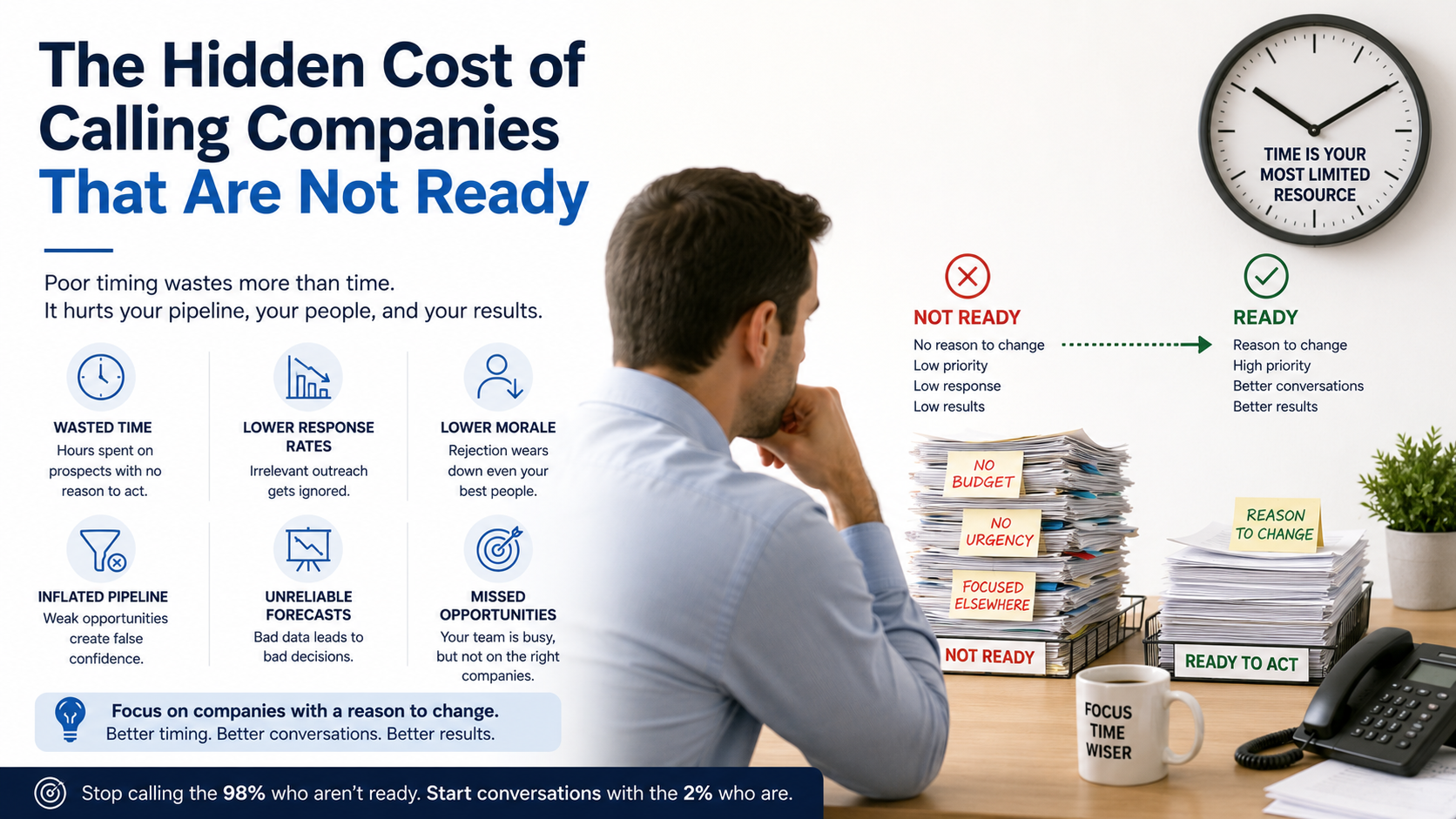
Most companies understand that sales prospecting requires persistence.
Not every call will be returned. Not every email will receive a response. Most prospects will not become customers.
That is part of selling.
But there is an important difference between accepting normal rejection and repeatedly directing salespeople toward companies that have no current reason to engage.
When prospecting is poorly timed, the cost is much higher than a few unanswered calls.
It affects salesperson productivity, morale, forecasting, pipeline quality, brand perception, and the organization’s understanding of what is actually working.
The sales team may appear busy while the company quietly absorbs the cost of pursuing the wrong accounts at the wrong time.
The Most Visible Cost Is Salesperson Time
Salespeople have a limited number of productive hours.
Every hour spent researching an account, identifying contacts, writing an email, making a call, leaving a message, and scheduling follow-up is an investment.
That investment makes sense when the company has a credible reason to engage.
It becomes much harder to justify when the prospect was selected only because it fits a broad demographic profile.
A salesperson may spend significant time pursuing a company that:
Recently renewed a contract with another supplier
Has no approved budget
Is satisfied with its current process
Has postponed the relevant project
Is reducing rather than increasing capacity
Has no internal pressure to change
Is focused on unrelated priorities
The account may still be a good potential customer someday.
It is simply not a productive use of concentrated sales effort today.
Poor Timing Reduces Response Rates
Executives often measure prospecting performance through response rates, meetings scheduled, opportunities created, and proposals issued.
When those numbers decline, the first conclusion is often that the messaging needs improvement or the salespeople need to increase activity.
Sometimes that is true.
But even an excellent message will struggle when the recipient has no current reason to care.
A plant manager who is dealing with a capacity problem may respond to a message about production efficiency.
The same plant manager may ignore that message when production is stable, and the facility is operating comfortably.
The quality of the offer has not changed.
The relevance of the timing has.
When sales teams contact too many companies outside a buying window, low response rates become almost inevitable.
Management may then attempt to solve the problem by increasing volume, which creates even more poorly timed outreach.
More Volume Can Make the Economics Worse
Suppose a sales team receives little response from a list of 500 companies.
The organization may conclude that it needs 5,000 companies.
That creates more records to review, more contacts to purchase, more email addresses to verify, more outreach to send, and more follow-up to manage.
The activity expands, but the underlying account-selection problem remains.
A larger list does not improve timing.
It spreads the same process across a larger market.
This can create the illusion that the organization is scaling its sales effort when it is actually scaling inefficiency.
Salespeople Begin to Lose Confidence in Prospecting
Repeatedly contacting companies that are not receptive has a predictable effect on morale.
Salespeople begin to expect silence.
They become less enthusiastic about researching accounts, personalizing messages, and making thoughtful calls because experience suggests the effort will not be rewarded.
Some become overly mechanical. They rush through lists, send generic emails, and focus on completing activity requirements.
Others avoid prospecting whenever possible and concentrate on existing customers or active opportunities, where their effort produces a clearer result.
This is often described as a motivation problem.
It may actually be a targeting problem.
A salesperson who regularly receives accounts with a credible reason to engage will usually approach prospecting differently from one who is expected to create urgency from a static list.
The CRM Becomes Filled With Weak Opportunities
When salespeople are measured on pipeline creation, they have a natural incentive to place prospects into the CRM.
A company that accepted a meeting may become an opportunity. A prospect that requested information may receive an estimated value. An account that expressed possible future interest may remain in the pipeline for months.
The CRM gradually fills with opportunities that are not truly active.
Some have no defined project. Others have no budget, urgency, decision process, or internal sponsor.
They remain because removing them would reduce pipeline coverage.
This creates a serious management problem.
Executives believe the organization has more opportunity than it actually does.
Inflated Pipelines Produce Weak Forecasts
Forecasting depends on the quality of what enters the pipeline.
When weak opportunities are included, sales leaders must continually explain why deals are not advancing.
Close dates move into the next month or quarter. Opportunity values are reduced. Probabilities are adjusted. Stalled deals remain visible because no one wants to formally close them as lost.
The forecast becomes an exercise in managing optimism.
The problem may not be that salespeople are poor forecasters.
It may be that prospects entered the pipeline before there was enough evidence of a real buying process.
A pipeline is more useful when it contains fewer opportunities supported by genuine business conditions than when it contains many possibilities with no momentum.
Management May Misdiagnose Sales Performance
When prospecting produces weak results, leadership understandably looks for causes.
The sales team may need better training. Messaging may need improvement. Activity standards may be too low. Follow-up may be inconsistent.
All of those possibilities should be examined.
But leadership should also ask whether the team is being directed toward enough companies with credible reasons to engage.
Without that question, management may attempt to repair the wrong part of the process.
It may coach salespeople to overcome objections that are actually the absence of need. It may rewrite messages for recipients who have no current interest. It may increase activity against accounts that are not moving.
A strong sales process cannot compensate indefinitely for weak opportunity selection.
Poor Timing Has an Opportunity Cost
The greatest cost may be the opportunities the sales team misses while pursuing inactive accounts.
Salespeople cannot give equal attention to every company.
Time spent following up with a low-readiness prospect is time not spent identifying an expanding company, researching a leadership change, responding to a supplier disruption, or approaching a business that has announced a new investment.
The organization loses twice.
It pays for unproductive activity and misses accounts where timing may be better.
This is why account prioritization matters.
The issue is not merely reducing wasted calls. It is redirecting attention toward companies where a meaningful conversation is more likely.
The Answer Is Not to Stop Prospecting
None of this means sales teams should contact only companies that have announced an immediate purchase.
Waiting for formal buying intent creates its own problem. By that point, competitors may already be involved, and the customer may have defined its requirements.
Sales teams still need to develop relationships before a purchase becomes obvious.
The goal is not certainty.
The goal is evidence.
A company undergoing expansion, leadership change, capacity growth, regulatory pressure, supplier disruption, or a major operational initiative gives the salesperson a stronger starting point than a company selected only because it matches a database filter.
The evidence provides context.
Context creates relevance.
Relevance improves the chance of engagement.
A Better Measure of Prospecting Productivity
Sales activity will always matter.
Calls must be made. Emails must be sent. Relationships must be developed. Follow-up must occur.
But activity should be measured alongside opportunity quality.
Executives should ask:
How were the accounts selected?
What makes them important now?
What business change may create a need?
How many prospects are showing real forward movement?
How many opportunities lack a defined project or reason to act?
Where is salesperson time producing the strongest engagement?
These questions help the organization distinguish productive prospecting from activity performed for its own sake.
The Objective Is Better Use of Sales Capacity
Salespeople are expensive, limited, and valuable resources.
Their time should not be consumed primarily by searching large databases and repeatedly contacting companies with no current reason to respond.
They should spend more of their effort understanding promising accounts, developing informed outreach, conducting useful conversations, and advancing legitimate opportunities.
That requires more than a list of companies that fit the profile.
It requires a way to identify which companies deserve attention now.
The next step is understanding why the ideal customer profile remains essential—but cannot answer that question by itself.