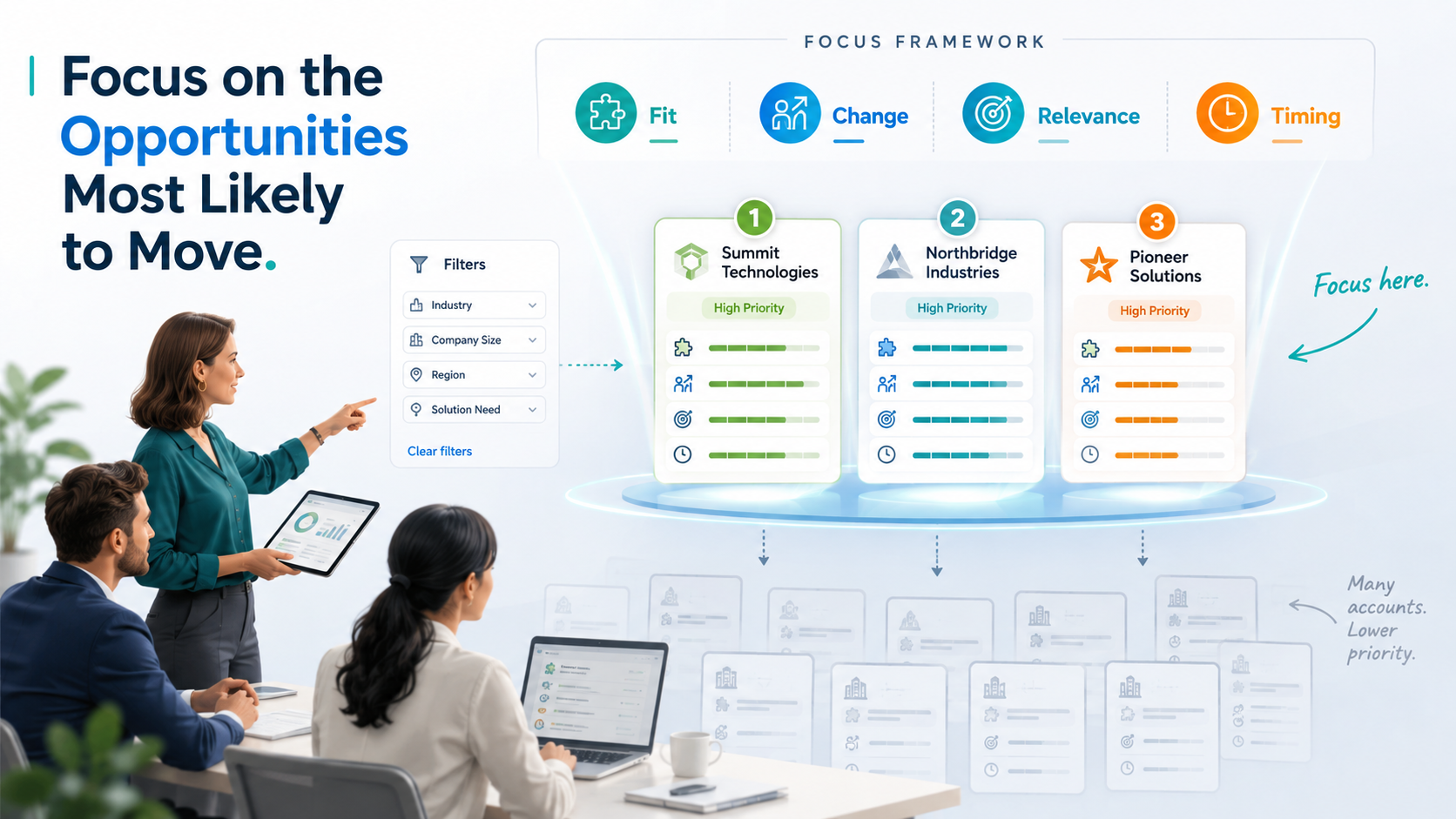
Most sales teams have more potential accounts than they have time for.
That creates a management problem.
Who should sales call first?
The biggest company?
The oldest lead?
The account with the highest estimated value?
The prospect who answered an email last month?
Those are understandable choices.
They are not always the best ones.
A better approach is to prioritize accounts based on four things:
Customer fit
Evidence of change
Commercial relevance
Timing
Start With Fit
First ask:
Is this the kind of company we actually want as a customer?
That means comparing the account with the Ideal Customer Profile.
Depending on the business, that may include:
Industry
Company size
Geography
Application
Facility type
Technology
Buying structure
Revenue potential
A company can be interesting without being a strong fit.
Salespeople should not spend equal time on every company simply because it exists in the database.
Then Look for Change
A strong-fit company may still have no reason to buy today.
That is where signals of change matter.
Examples include:
Expansion
New leadership
Acquisition
Rapid hiring
Funding
New products
New facilities
Regulatory pressure
Supplier problems
These events can indicate that the company has moved from a stable situation into an investigation period.
That does not guarantee an opportunity.
It increases the reason to investigate.
Ask Whether the Change Matters to You
Not every change creates a relevant sales opening.
A company may be expanding—but the expansion may have nothing to do with what you sell.
The sales team should ask:
Could this development create a problem, a requirement, or a decision that our company can help with?
For example:
A facility expansion may matter greatly to an engineering firm, an automation supplier, an equipment manufacturer, or a commercial contractor.
The same expansion may be irrelevant to another seller.
Commercial relevance is what connects the signal to your value proposition.
Timing Matters
Two identical companies can deserve very different levels of sales attention depending on when the change occurred.
A company that announced a major project yesterday may still be investigating options.
Another company may have announced the same project six months ago and already selected vendors.
The Economic Gardening sales-window model describes this progression as motivation, investigation, evaluation, and selection. The strongest opportunity for a new seller is often early enough in that window to influence the decision.
That makes recency important.
Good opportunities can go stale.
A Simple Prioritization Model
Instead of asking salespeople to work through lists from top to bottom, rank accounts using four questions:
Fit
Is this a company we want?
Change
Is something meaningful happening?
Relevance
Could that change create a need we address?
Timing
Is there still time to influence the decision?
An account that scores strongly in all four areas should rise to the top.
The Biggest Account Is Not Always the Best Account
Salespeople naturally gravitate toward recognizable names.
Large companies feel important.
But a large company with no apparent reason to change may be a lower-probability prospect than a smaller, well-matched company that has just announced a major initiative.
Sales capacity is limited.
The objective should not be to call the most impressive names.
It should be to spend time where the probability of a useful conversation is highest.
Separate “Monitor” From “Contact Now”
Not every strong-fit account needs immediate outreach.
A useful prioritization system should create several categories:
Contact now
Strong fit, meaningful change, clear relevance, good timing.
Research further
Promising account, but more information is needed.
Monitor
Strong fit, but no current reason to engage.
Dismiss
Weak fit or low relevance.
This prevents salespeople from treating every account as equally urgent.
It also protects good companies from being prematurely discarded simply because the timing is not right.
AI Can Help Prioritize at Scale
Doing this manually for hundreds or thousands of companies is difficult.
AI can help compare accounts, summarize developments, classify signals, evaluate fit, and surface the strongest candidates for review.
That is where Intercept Advantage fits.
Intercept Advantage monitors the target market, identifies signals of change, evaluates relevance, and helps prioritize the accounts that appear most worthy of sales attention.
The salesperson still makes the final decision.
The advantage is that they begin with a much smaller, stronger set of possibilities.
Focus Is a Sales Strategy
A sales team cannot pursue everything equally well.
The companies most likely to move are usually those where four things come together:
Right company
Right change
Right relevance
Right timing
That is a better way to allocate sales capacity than simply starting at the top of a list and working downward.