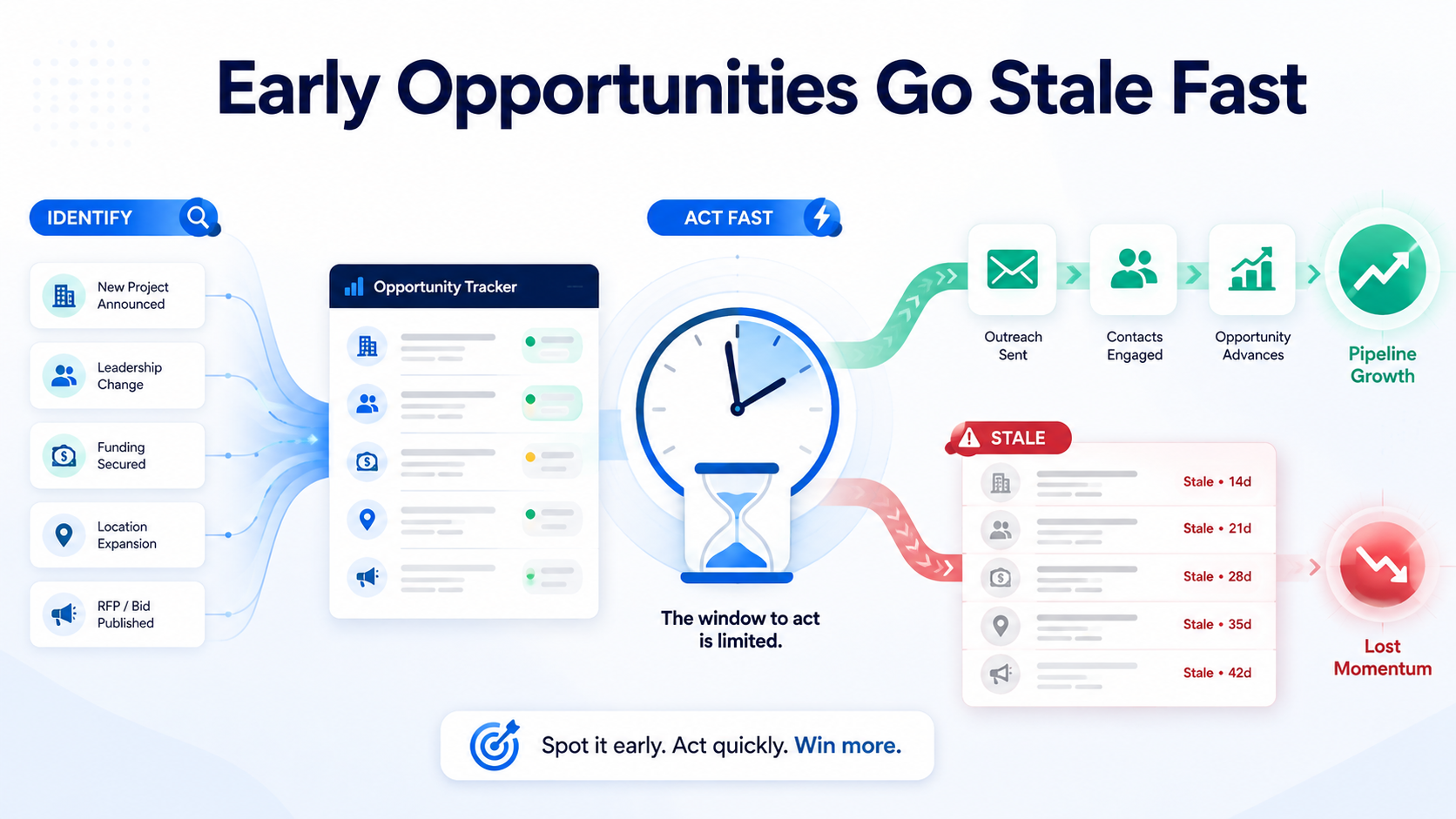
Finding a high-potential opportunity before competitors do is valuable.
But identifying it is only half the job.
The advantage disappears when the opportunity sits untouched for days or weeks while the sales team handles other priorities.
By the time someone finally sends an email, the prospect may already be talking with competitors, defining project requirements, developing a shortlist, or moving toward a decision.
Early intelligence creates a head start.
Slow execution gives it back.
Sales Opportunities Have a Shelf Life
A business does not remain equally receptive forever.
Most purchases move through a process:
Something creates motivation.
The company investigates its options.
It evaluates the strongest alternatives.
It selects a solution.
This period can be thought of as a sales window. The probability of a productive conversation increases after motivation is created and then declines as the decision approaches or is completed.
Signals such as an expansion, a leadership change, an acquisition, a funding award, a new facility, a product launch, a regulatory issue, or a supplier problem may indicate that the window has opened.
But open windows do not stay open.
A company announcing a project today may be researching options tomorrow. A week later, it may already have assembled a shortlist. A month later, much of the buying process may be complete.
That is why the age of an opportunity matters.
The First Credible Supplier Gains an Advantage
Early in the buying process, the prospect is still trying to understand:
What the project requires
Which risks need to be addressed
What alternatives are available
Which suppliers appear credible
How the decision should be structured
What questions should be asked
A knowledgeable salesperson who enters during this stage may help the buyer frame the problem.
That can create a meaningful competitive advantage.
The supplier may influence specifications, introduce evaluation criteria, identify overlooked risks, and become a trusted source before other vendors arrive.
This is the logic of intercept marketing: engage the buyer during the investigation stage rather than waiting until the company has completed its research and is choosing among established finalists.
The later the salesperson enters, the less influence remains.
A Stale Opportunity Is Not Just an Administrative Problem
When an opportunity dashboard shows that an account has gone stale, that is not merely a reminder to update the CRM.
It is a warning that competitive position may be deteriorating.
Every day of delay creates several risks:
A competitor may contact the account first.
The buyer may begin defining the project without your input.
Existing suppliers may reinforce their relationships.
The most relevant contacts may become harder to reach.
The original signal may lose immediacy.
The outreach may sound late rather than insightful.
A facility expansion reported two days ago is timely context.
The same announcement referenced six weeks later may sound like old news.
Sales intelligence has maximum value while the development is still current.
Contact Research Is Not Sales Execution
Finding the right contacts is important.
It removes one of the largest barriers to outreach. The salesperson does not need to search for the company, interpret the opportunity, identify the relevant executives, and locate contact information from scratch.
But a completed contact record is not the same as a completed sales action.
The value is created only when someone:
Reviews the opportunity
Selects the best contacts
Develops a relevant message
Sends the outreach
Follows up
Records the response
Advances or dismisses the account
A sales intelligence system can identify and prioritize opportunities.
The salesperson still has to enter the race.
Speed Does Not Mean Careless Outreach
Fast follow-up should not mean immediately sending a generic message to every contact.
The goal is prompt, informed action.
A strong first message can be simple:
I saw that your organization is moving forward with [project or change]. Developments like this often create questions around [relevant issue]. We have supported similar organizations during this stage and thought a brief introduction might be timely.
That message uses four elements:
A current business development
A plausible implication
A relevant capability
A low-pressure reason to speak
The outreach does not need to be perfect.
It needs to be credible, relevant, and timely.
Sales Managers Need a Response Standard
Companies that invest in early identification of opportunities should establish an internal service standard for sales follow-up.
A practical model might be:
Highest-priority opportunities: Review within one business day
Strong-fit opportunities: Initial outreach within two business days
Lower-confidence opportunities: Research, monitor, or dismiss promptly
No action taken: Escalate or reassign after a defined period
The exact timing can vary.
What matters is that identified opportunities do not sit indefinitely without a decision.
Every account should move into one of four categories:
Contact now
Research further
Continue monitoring
Dismiss
“No decision” should not become the default status.
Management Should Track Opportunity Aging
Most pipeline reviews focus on deals already in progress.
Sales managers should also review the age of newly identified opportunities.
Useful questions include:
How many high-priority opportunities are awaiting first contact?
How long have they been waiting?
Were relevant contacts already provided?
Who owns the next action?
Why has outreach not occurred?
Should the account be reassigned?
Which opportunities are becoming stale?
A visible stale-day indicator makes delay measurable.
It makes clear that the company is not simply storing opportunities. It is managing perishable sales assets.
AI Can Find Opportunities Faster Than Sales Can Manually Research Them
AI can monitor large volumes of public information, compare companies with the Ideal Customer Profile, summarize business developments, assess potential relevance, and prepare account context.
That can reduce days of manual research to minutes.
But accelerating opportunity identification while leaving sales follow-up unchanged creates a bottleneck.
The intelligence arrives faster.
The sales process does not move faster.
Companies therefore need to align two capabilities:
Rapid opportunity identification
Rapid sales response
Either one without the other produces limited value.
The Competitive Advantage Is Identification Plus Execution
Intercept Advantage is designed to help companies identify high-fit businesses showing meaningful signals of change, prioritize the strongest opportunities, and provide the context and contacts needed for outreach.
But the platform cannot create urgency inside the sales organization.
Management must ensure that high-value opportunities receive prompt attention.
The winning formula is straightforward:
Find the opportunity early. Understand why it matters. Contact the right people while the sales window is still open.
Early opportunity identification creates the advantage.
Sales execution converts that advantage into conversations, pipeline, and revenue.