When sales results slow down, most companies start by looking at the sales team.
Are representatives making enough calls?
Are they sending enough emails?
Are they following up quickly enough?
Are they entering everything into the CRM?
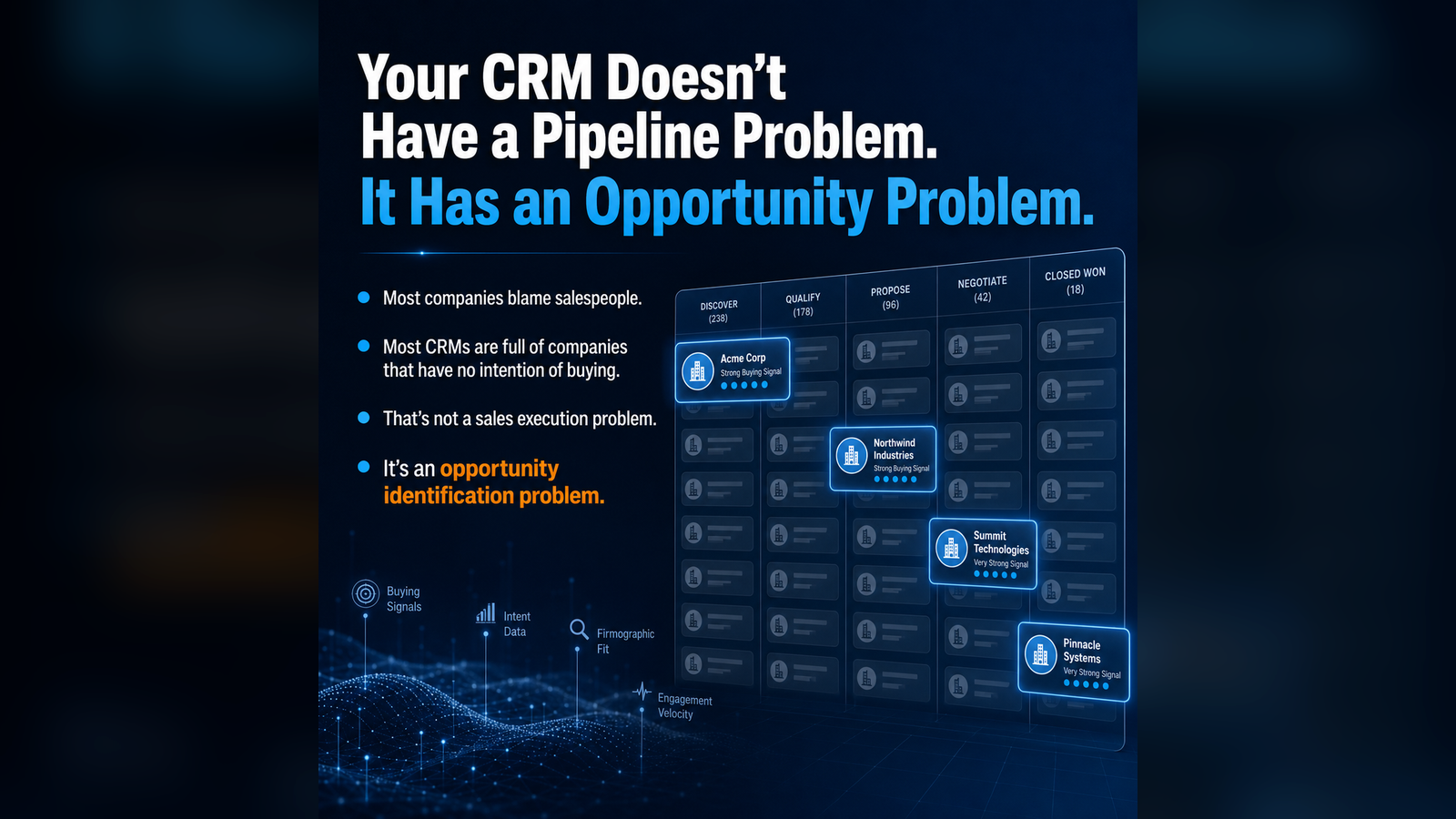
Those are reasonable questions. But they often overlook the real issue. Your CRM may be full of companies, contacts, and activities without containing enough organizations that are actually likely to buy. That is not primarily a sales execution problem. It is an opportunity identification problem.
A Full CRM Is Not the Same as a Healthy Pipeline
Most CRMs are designed to organize information. They record contacts, track conversations, assign tasks, document opportunities, and forecast potential revenue. They are extremely useful once the right company has entered the sales process.
But a CRM cannot create buying intent where none exists. A database may contain thousands of companies that fit your general target market. That does not mean those companies are preparing to make a change. Some may be satisfied with their current supplier. Others may have no available budget, no active project, no leadership pressure, and no reason to take a meeting. They may be qualified on paper, but they are not opportunities.
That distinction matters. A company can match your ideal customer profile and still have no intention of buying from anyone this year.
Why More Sales Activity Often Fails
When the pipeline looks weak, the standard response is usually to increase activity:
Add more names to the CRM,
Purchase another contact list
Increase outbound call volume
Launch another email sequence
Hire another salesperson
Push the team to schedule more meetings
These actions can create motion without creating meaningful progress.
If salespeople are contacting companies that have no reason to change, more activity simply produces more rejection, more ignored emails, and more frustration.
The sales team may be working hard. The problem is that it is working from a weak opportunity set. No amount of follow-up discipline can turn a company with no active need into a high-probability prospect.
The Best Opportunities Usually Begin With Change.
Companies are most open to a sales conversation when something inside the business is changing. That change may involve:
Opening or expanding a facility
Hiring a new executive
Acquiring another company
Entering a new market
Launching a new product
Receiving new funding
Investing in equipment
Changing production capacity
Announcing a major project
Experiencing rapid growth
Replacing an incumbent supplier
Responding to a new regulatory or operational requirement
These events create pressure, urgency, complexity, and new purchasing needs.
They are buying signals.
A company that recently announced an expansion is fundamentally different from a similar company that has been operating without change for five years. Both may fit your ideal customer profile, but only one is showing evidence that a relevant conversation could be timely.
That is the difference between a target account and an active opportunity.
Your CRM Manages Opportunities. It Does Not Find Them.
Most CRMs begin working after someone has already decided which companies to pursue. They are systems of record, not necessarily systems of discovery. They can tell you:
Who was contacted
What was discussed
When the next follow-up is due
How much an opportunity may be worth
Where the deal sits in the sales process
They usually cannot tell you:
Which companies are undergoing meaningful change
Which accounts are showing relevant buying signals
Why a particular company deserves attention now
Which prospects should move to the top of the list
What event could provide a credible reason to reach out
Without that intelligence, the CRM becomes a storage system for names rather than a source of prioritized sales opportunities.
Opportunity Intelligence Changes the Sales Conversation
Traditional prospecting often begins with a generic introduction:
We work with companies like yours and would like to tell you about our capabilities.
Opportunity-based prospecting begins with relevance:
I saw that your company is expanding its production facility. We often help manufacturers address the operational and supplier challenges that arise during expansions like this.
The second message is more likely to earn attention because it is connected to something happening inside the prospect’s business.
The salesperson is no longer asking the company to manufacture interest. The salesperson is responding to evidence that a need may already be forming.
This produces several advantages:
Better account prioritization
More credible outreach
Higher-quality conversations
Less wasted sales activity
Faster qualification
Stronger pipeline confidence
The goal is not simply to find companies that could buy. The goal is to find companies with a reason to consider buying now.
Buying Signals Are More Valuable When Combined
A single signal may be interesting. Several aligned signals can be persuasive. For example, a manufacturer may:
Announce a facility expansion
Hire a new vice president of operations
Increase engineering recruitment
Receive approval for a major capital investment
Begin discussing new production capabilities
Individually, each event provides some insight. Together, they suggest that the company may be entering a period of significant operational change.
Stop Treating Every Prospect Equally
Most sales databases contain a mixture of:
Strong opportunities, Long-term possibilities
Poor-fit companies
Dormant accounts
Companies with no current need
When every company receives roughly the same attention, the highest-potential opportunities can disappear inside the volume.
A better system ranks companies according to both fit and timing.
The highest-priority accounts are not simply the largest companies or the contacts with the most complete records. They are the organizations where meaningful business change intersects with your company’s value proposition.
That is where sales effort has the greatest chance of producing a return.
Better Pipeline Starts Before the CRM
A healthier pipeline does not begin with more contacts. It begins with better decisions about which companies deserve to enter the sales process. Before asking the sales team to increase activity, ask four questions:
Are we identifying companies that are actively changing?
Do we know why each priority account may need us?
Can our salespeople explain why they are reaching out now?
Are we separating general market fit from genuine opportunity?
When the answer is no, adding more activity will not solve the underlying problem. The company needs a better opportunity identification process.
Turn Market Change Into Sales Opportunity
Intercept Advantage helps B2B companies identify high-probability opportunities by monitoring the market for meaningful buying signals. Instead of handing salespeople another static list of names, it helps them see which companies are expanding, hiring, investing, acquiring, launching, and changing.
That gives the sales team something far more valuable than another contact record. It gives them a reason to start the conversation. Your CRM can manage the pipeline. Intercept Advantage helps you find the opportunities that belong in it.
Request a live demonstration of the Intercept Advantage Sales Opportunity Intelligence Platform.