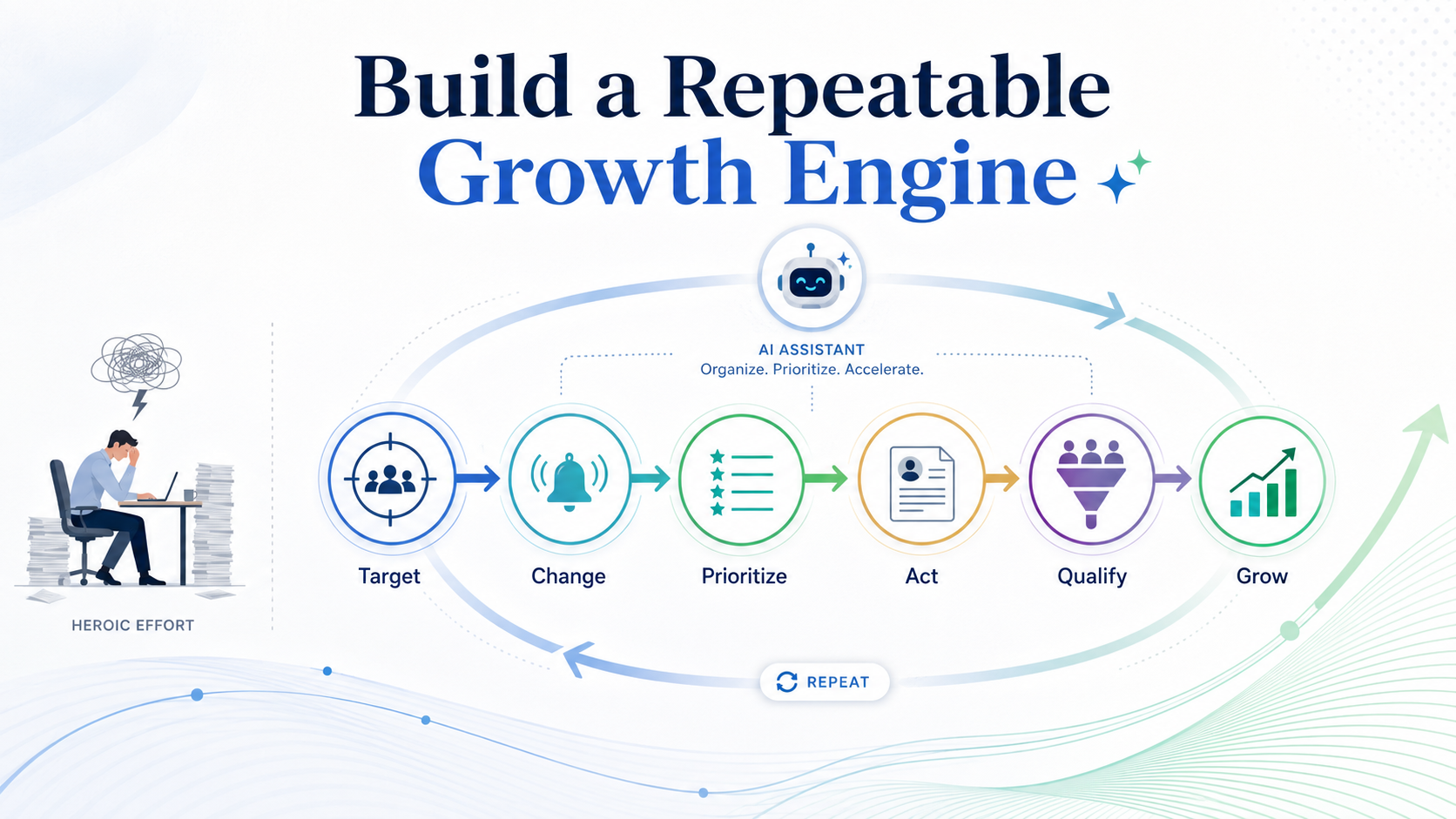
Every sales organization has a few people who seem able to manufacture business out of thin air.
They know the market
They know the customers
They know who to call.
They remember which account was planning an expansion six months ago
And somehow, they keep finding opportunities
Those people are valuable, but they are not a sales system
If growth depends on a handful of exceptional salespeople working harder, remembering more, and prospecting better than everyone else, the business becomes difficult to scale.
A stronger organization builds a repeatable growth engine.
Start With the Right Market
The first step is deciding which companies deserve attention.
That means defining the Ideal Customer Profile clearly enough that sales can distinguish between:
A possible customer
A good customer
A high-value customer
Without that discipline, salespeople pursue whatever looks interesting.
The result is scattered effort.
Watch for the Right Time
Even a perfect-fit company may have no reason to buy today.
Most organizations operate in stable environments most of the time.
Something usually has to change before a customer seriously considers a new supplier, new system, or new approach.
That change might be an expansion, new leadership, funding, an acquisition, a new product, a regulatory issue, or another significant event. These signals can indicate a company is moving from stability to active investigation.
Timing changes the probability of a productive sales conversation.
Prioritize Before Sales Starts Prospecting
Once you identify companies, don't treat them all equally.
Prioritize using a simple combination of:
Fit — Is this the right kind of customer?
Change — Is something meaningful happening?
Relevance — Could that change create a need you address?
Timing — Is the opportunity still fresh enough to influence?
This moves the sales team away from working down static lists and toward working the strongest opportunities first.
Give Salespeople Context
A name and email address are not enough.
The salesperson should know:
Why the company fits
What changed
Why the development may matter
Who appears relevant
When the signal occurred
What source supports it
That turns prospecting from research into execution.
The salesperson can spend more time deciding how to engage instead of determining whether the company deserves attention at all.
Act While the Window Is Open
The buying process generally moves through motivation, investigation, evaluation, and selection. The strongest opportunity for a new supplier is often during the investigation stage, before the buyer has narrowed the field.
That means speed matters.
A high-quality opportunity left untouched for weeks can become stale.
Sales organizations need a response standard.
Good opportunities should be reviewed, assigned, and acted on promptly.
Qualify Honestly
Not every strong prospect becomes a real opportunity.
Sales still needs to confirm:
Is there a real business issue?
Is there a reason to act?
Is the right person engaged?
Is there a plausible buying process?
Is there a next step?
Good opportunity intelligence improves the starting point.
Good qualification protects the pipeline.
You need both.
Manage Movement
Once an opportunity enters the pipeline, management should focus on movement.
Ask:
What changed?
What did the buyer do?
What is the next step?
What is blocking progress?
Should this deal still be open?
A pipeline should represent active business decisions, not a collection of hopeful possibilities.
Use AI Where It Saves Time
AI can support almost every stage before the human sales conversation.
It can help:
Monitor large markets
Identify signals
Compare companies with the ICP
Summarize developments
Prioritize accounts
Prepare account briefs
Draft initial outreach
Reduce administrative work
The goal is not to automate selling.
The goal is to remove low-value work around selling.
Salespeople should spend their best hours having conversations, conducting discovery, advancing opportunities, and building relationships.
Measure the Right Things
A growth engine should measure more than call volume.
Track:
Strong-fit accounts identified
Priority prospects contacted
Relevant conversations started
Qualified opportunities created
Opportunities advanced
Stalled deals removed
Win rates
Revenue
These metrics tell management whether the system is producing movement.
Make Growth Repeatable
A sustainable sales growth system looks something like this:
Define the market.
Monitor for change.
Prioritize the strongest accounts.
Provide sales-ready context.
Act quickly.
Qualify rigorously.
Advance the real opportunities.
Use AI to reduce low-value work.
Measure results.
Improve the process.
Intercept Advantage supports the front end of that system by monitoring target markets, identifying signals of change, and helping prioritize companies that may be entering a buying window.
But technology is only one piece.
The larger goal is to build a sales organization where opportunity creation is systematic, not accidental.
Heroic salespeople will always be valuable.
A strong growth engine ensures the business doesn't depend on them.