Sales teams often build prospecting around a calendar.
Call blocks happen Monday morning. Email sequences launch on Tuesday. Follow-up happens every Thursday. Activity is scheduled because consistency matters.
But timing in sales is not really about the day of the week.
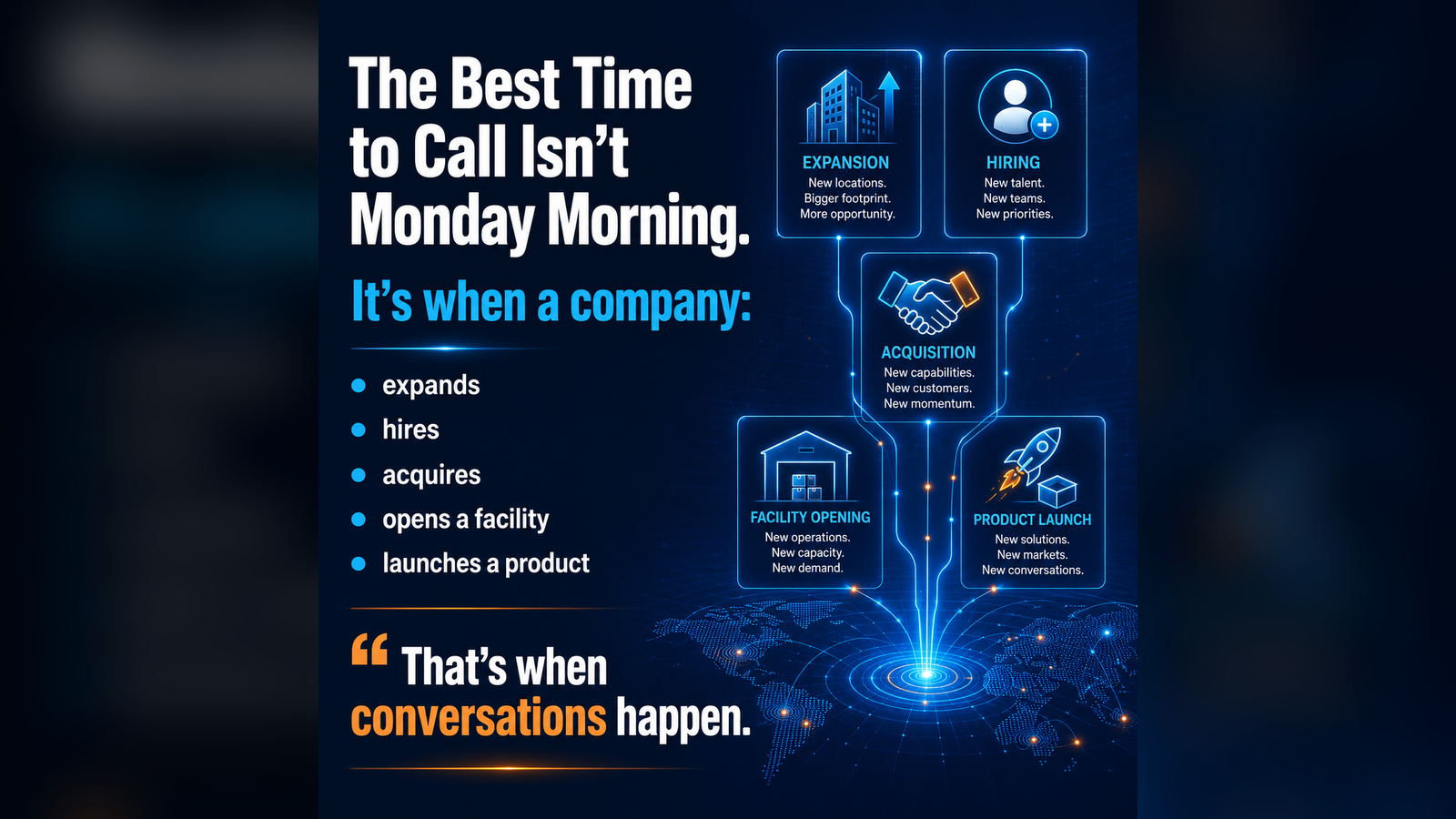
The best time to contact a company is when something inside that company has changed.
That is when priorities shift, budgets move, new problems appear, and established vendor relationships become less secure.
That is when conversations happen.
Most Prospecting Is Based on Convenience
Traditional prospecting usually starts with a list.
The salesperson works through that list according to a fixed cadence:
Call
Email
Connect on LinkedIn
Follow up
Repeat
The process may be disciplined, but the timing is arbitrary.
The salesperson is reaching out because the company appeared next in the CRM—not because the company has a reason to listen.
That creates a predictable problem.
Even a well-matched company may ignore the outreach if nothing is happening internally. The message may be good. The salesperson may be credible. The solution may be relevant.
But without change, there may be no urgency.
Change Creates Openings
Companies tend to reconsider suppliers, systems, processes, and priorities when they are in motion.
A business that is stable has strong reasons to maintain the status quo. Existing processes are familiar. Current vendors are known. Employees understand how things work.
Change disrupts that stability.
It creates new questions:
Can our current suppliers support our next phase?
Do we need additional capacity?
Are our systems still adequate?
Do we need new expertise?
Can our existing team handle the workload?
Should we standardize, replace, or upgrade something?
Those questions create sales opportunities.
Expansion Creates New Demand
When a company expands, almost everything gets reconsidered.
Expansion may involve a new territory, a larger production footprint, additional equipment, more employees, or increased capacity.
That growth can create needs related to:
Infrastructure
Technology
Logistics
Staffing
Engineering
Compliance
Facilities
Professional services
New suppliers
An expanding company may not be actively searching for your solution yet. But it is entering a period when old assumptions no longer apply.
That makes the expansion announcement more than news.
It is a potential buying signal.
Hiring Reveals New Priorities
Hiring activity can provide an early view into where a company is headed.
A few job postings may indicate normal turnover. A pattern of hiring can indicate something more significant.
A company adding engineers may be developing new products. A growing operations team may signal increased production. A new vice president may bring new goals, new vendors, and a willingness to reconsider existing relationships.
Hiring does not automatically mean a company needs what you sell.
But it often tells you where leadership is investing.
That information gives a salesperson a better reason to investigate and a more relevant way to begin the conversation.
Acquisitions Create Complexity
An acquisition creates immediate change for both organizations.
Leadership teams must integrate systems, suppliers, facilities, processes, employees, and reporting structures. Duplicate capabilities may be consolidated. New investments may be approved. Existing contracts may be reviewed.
Acquisitions create uncertainty, but they also create momentum.
The acquiring company may need help scaling. The acquired company may need to meet new standards. Both sides may reconsider how work is performed and who supports it.
A salesperson who recognizes that change can approach the account with context instead of a generic pitch.
New Facilities Create New Buying Decisions
Opening a facility is one of the clearest signs of potential demand.
A new location may require equipment, systems, contractors, technology, suppliers, maintenance, training, and operational support.
Even when a company already has preferred vendors, a new facility can exceed existing capacity or create needs that current suppliers cannot address.
The strongest opportunities may appear before the facility opens.
By the time the public ribbon-cutting occurs, many major decisions have already been made.
That is why early detection matters.
The sooner the sales team recognizes the project, the more likely it is to participate while options are still being evaluated.
Product Launches Create New Conversations
A new product can create needs throughout the organization.
The company may need help with design, testing, manufacturing, packaging, automation, distribution, marketing, regulatory compliance, or customer support.
A launch can also signal entry into a new market or a major change in strategic direction.
The product itself may not be directly related to what you sell. The organizational activity surrounding it may be.
Good opportunity identification looks beyond the announcement and asks:
What must this company do next to make the launch successful?
That is where the real sales conversation often begins.
A Buying Signal Is Not a Guaranteed Sale
A business change does not prove that a company will buy from you.
It provides something more useful than a cold name: a reason to pay attention.
The signal tells the salesperson:
This account may be entering a buying window
Existing needs may be growing
New decision-makers may be involved
Current suppliers may be reconsidered
A timely conversation may be possible
The next step is qualification.
Does the company fit your ideal customer profile? Is the change relevant to your offering? Can you identify the likely decision-makers? Do multiple signals point in the same direction?
A signal should guide research—not replace it.
Better Timing Produces Better Outreach
A generic sales message focuses on the seller:
We provide solutions for companies in your industry and would like to schedule an introductory meeting.
A signal-based message focuses on the prospect:
I saw that your company is opening a new facility in Ohio. We help manufacturers address the equipment and operational challenges that often come with new production sites.
The second message is not automatically persuasive. But it is timely, specific, and grounded in something the prospect recognizes.
That gives it a much better chance of earning attention.
Sales Teams Need a Market Clock, Not Just a Calendar
Consistent activity still matters.
Salespeople should maintain call blocks, follow-up routines, and pipeline discipline. But those systems should support opportunity timing, not substitute for it.
The sales team needs to know not only who fits, but who is moving.
That requires continuous monitoring for events such as:
Expansions
Executive changes
Hiring surges
Acquisitions
Facility openings
Product launches
Capital investments
Funding announcements
Major contracts
Regulatory changes
These signals create a market clock.
They tell the sales team when an account may be entering a period of increased need and greater openness to change.
Stop Asking, “When Should We Call?”
Monday morning is not necessarily a bad time to call.
It is simply not the reason to call.
The better question is:
What has changed inside this company that makes a conversation timely?
When the sales team can answer that question, outreach becomes more relevant, account prioritization improves, and conversations are more likely to move forward.
Contact Companies When the Timing Is Real
Intercept Advantage helps B2B sales teams identify companies that are expanding, hiring, acquiring, opening facilities, launching products, and undergoing other meaningful changes.
Instead of working through static lists according to an arbitrary schedule, salespeople can focus on accounts with a credible reason to engage.
Because the best time to call is not Monday morning.
It is when something changes.